Dark energy appears to be a pervasive, invisible component of the cosmos responsible for the observed acceleration of cosmic expansion. In this article you’ll learn where the idea came from, the main observational evidence, the dominant theoretical explanations, and why dark energy remains one of the greatest unsolved puzzles in modern physics.
Introduction
Dark energy was introduced to explain an astonishing discovery: the expansion of the universe is speeding up rather than slowing down. This finding, first robustly established in the late 1990s, implies either a previously unknown component of the universe or a need to rethink gravity on the largest scales. For students and curious readers, understanding dark energy is a journey across observation, theory, and continuing mystery.
How scientists discovered dark energy
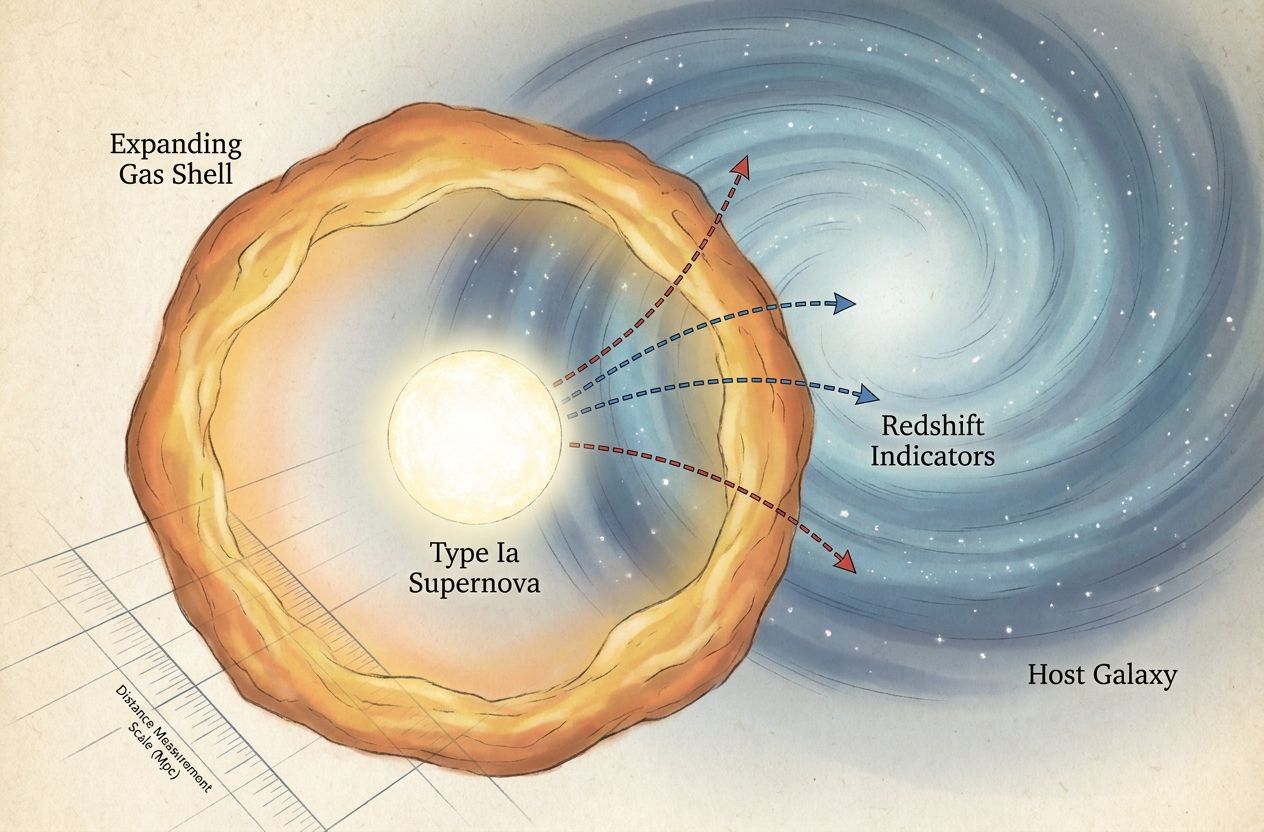
The discovery rests on several complementary observational pillars. The most famous is the work with Type Ia supernovae — exploding stars that act as “standardizable candles”. Two independent teams, the Supernova Cosmology Project and the High-Z Supernova Search Team, measured distances to distant Type Ia supernovae and compared them with the redshifts of their host galaxies. Instead of the expected deceleration caused by gravity, distant supernovae appeared dimmer than anticipated, implying they were farther away — a signature of an accelerating universe. For an accessible overview of the discovery, see NASA’s page on the accelerating universe.
Other lines of evidence
- Cosmic Microwave Background (CMB): Observations of the CMB, especially by the WMAP and Planck satellites, map the universe’s geometry. The CMB indicates a nearly flat universe, but matter (both ordinary and dark matter) accounts for only about 30% of the critical density. The missing density is consistent with a smooth component like dark energy.
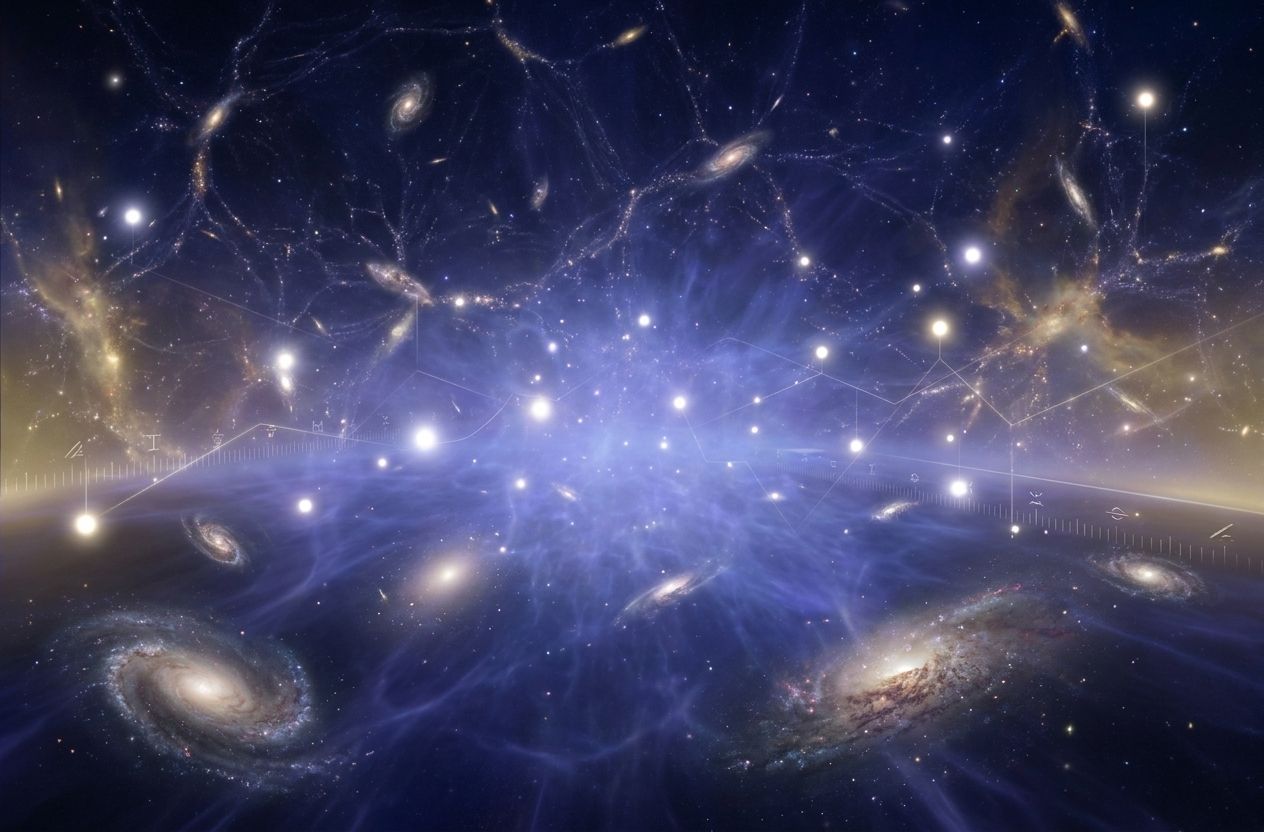
- Baryon Acoustic Oscillations (BAO): BAO in the large-scale distribution of galaxies serve as a “standard ruler”. Measurements of BAO across cosmic time align with models that include dark energy driving accelerated expansion.
- Large-scale structure: The growth rate of cosmic structure and galaxy clustering patterns are best fit when dark energy is included in cosmological models.
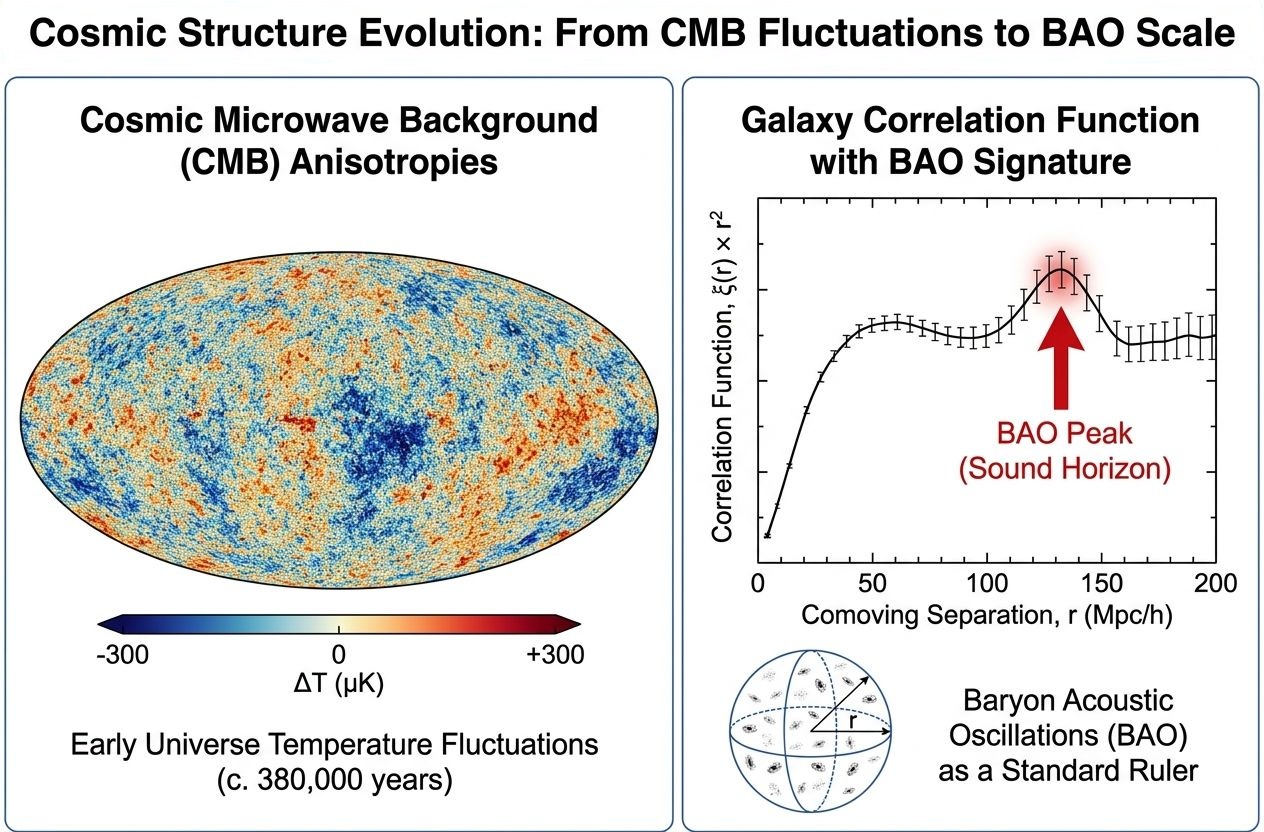
Together, these datasets provide converging evidence that the universe’s expansion is accelerating and that about 68–70% of the universe’s energy density behaves like dark energy.
What exactly is dark energy?
Short answer: we don’t know. Several leading ideas compete, each with different implications:
1) The cosmological constant (Λ)
Proposed by Albert Einstein and later reinterpreted, the cosmological constant is the simplest explanation: a constant energy density filling space uniformly. In Einstein’s field equations, Λ acts like a uniform pressure that accelerates expansion. In the standard ΛCDM model (Lambda Cold Dark Matter), Λ combined with cold dark matter explains the broad features of cosmological observations.
2) Vacuum energy
Quantum field theory predicts a vacuum energy from zero-point fluctuations. If vacuum energy acts like a cosmological constant, it could be the source of dark energy. However, naive estimates of vacuum energy density exceed the observed value by many orders of magnitude — this mismatch is the notorious cosmological constant problem.
3) Dynamical fields (quintessence)
In this class of models, a slowly varying scalar field (often called quintessence) evolves over time and drives acceleration. Unlike the cosmological constant, quintessence can change with cosmic time and might leave detectable signatures in the expansion history and structure growth.
4) Modified gravity
Another possibility is that on the largest scales gravity behaves differently from General Relativity (GR). Modified gravity theories attempt to reproduce cosmic acceleration without a new energy component, by altering the laws that determine how matter and spacetime interact. These models are constrained by solar system tests, gravitational wave observations, and cosmological surveys.
How dark energy affects the universe
Dark energy shapes cosmic history in several crucial ways:
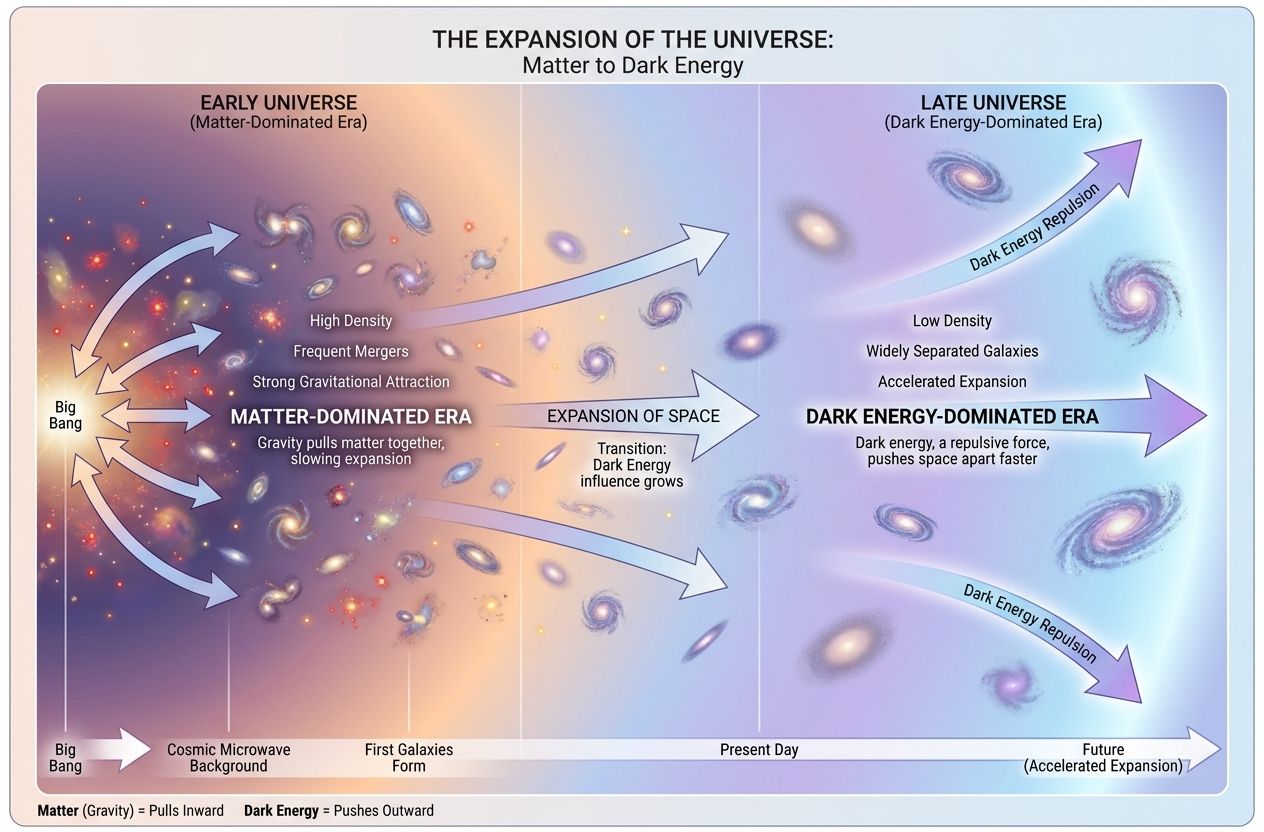
- Accelerated expansion: Dark energy causes the expansion rate to increase, stretching space so galaxies recede from each other faster over time.
- Structure formation slowdown: As dark energy becomes dominant, the gravitational growth of galaxy clusters and large-scale structures slows, affecting when and how galaxies form and cluster.
- Future cosmic fate: The long-term outcome for the universe depends on dark energy’s nature. If dark energy is a true cosmological constant, expansion will continue accelerating forever, leading to a cold, diluted cosmos often called the “Big Freeze.” If dark energy evolves, other futures — including a Big Rip or a slowing expansion — become possible.
Key mysteries and challenges
Dark energy raises deep theoretical and observational puzzles:
- Why is the energy scale so small? The observed dark energy density (~10^-29 g/cm³) is extraordinarily tiny compared to particle physics scales. Explaining this smallness is a major theoretical challenge.
- Is dark energy constant or evolving? Distinguishing a true cosmological constant from dynamical models is a central goal of modern cosmology.
- Is the problem of vacuum energy solved by new principles? Solutions might require new symmetries, modifications to quantum field theory, or anthropic reasoning within a multiverse.
- Can modified gravity mimic dark energy? If so, how do we design experiments and observations to tell the difference?
How scientists try to answer these questions
Progress relies on precise measurements across cosmic time and scale. Key observational strategies include:
- Deeper, larger supernova surveys to map the expansion history with higher precision.
- Galaxy redshift surveys and BAO mapping to measure distances and the geometry of space.
- Improved CMB observations to refine measurements of the early universe and its parameters.
- Weak gravitational lensing to trace how structure grows under gravity and compare growth to expansion history.
Major projects contributing or planned include the Planck mission (legacy CMB), the Sloan Digital Sky Survey, the Vera C. Rubin Observatory (LSST), ESA’s Euclid mission, and NASA’s Roman Space Telescope. These efforts will tighten constraints on the nature of dark energy and test competing theories.
Simple analogies to build intuition
Analogies help, though they are imperfect. Imagine the universe as an expanding balloon:
- If expansion were driven only by the initial push (like blowing air into the balloon) and gravity were slowing it, the pace of expansion would fall over time.
- Dark energy acts like a continuous, gentle pressure inside or outside the balloon that causes expansion to accelerate despite gravity’s pull.
Another analogy: picture the cosmic expansion as a car moving along a road. Matter’s pull is like friction slowing the car, while dark energy is like a gradually increasing uphill push that makes the car speed up instead of slowing down.
What students and curious readers should remember
- Dark energy is a name for the cause of cosmic acceleration, not yet a fully understood physical entity.
- The leading explanation today is the cosmological constant (Λ) within the ΛCDM framework, which fits the data well but leaves major theoretical puzzles.
- Multiple independent observations — supernovae, the CMB, BAO, and structure growth — converge on the need for dark energy in current models.
- Ongoing and future surveys aim to measure whether dark energy evolves with time or is truly constant, which will be decisive for theory.
Further reading and reliable sources
For those who want to go deeper, these trusted sources provide excellent introductions and technical background:
- NASA: The Accelerating Universe
- ESA: Euclid Mission
- Original supernova discovery papers (archived)
- Review articles on dark energy and cosmology (Annual Review)
Conclusion
Dark energy is central to our modern picture of the cosmos. While observations robustly show that the universe’s expansion is accelerating, the physical origin of this acceleration remains unknown. Whether dark energy is a cosmological constant, a dynamical field, or a sign that gravity needs revision, solving this mystery will reshape our understanding of fundamental physics and the ultimate fate of the cosmos. For students and enthusiasts, following the observational campaigns and the theoretical debates offers a front-row seat to one of science’s most exciting open questions.
Curious to learn more? Explore the links above, follow upcoming survey results, and don’t hesitate to dive into introductory textbooks on cosmology for the mathematical underpinnings behind these ideas.