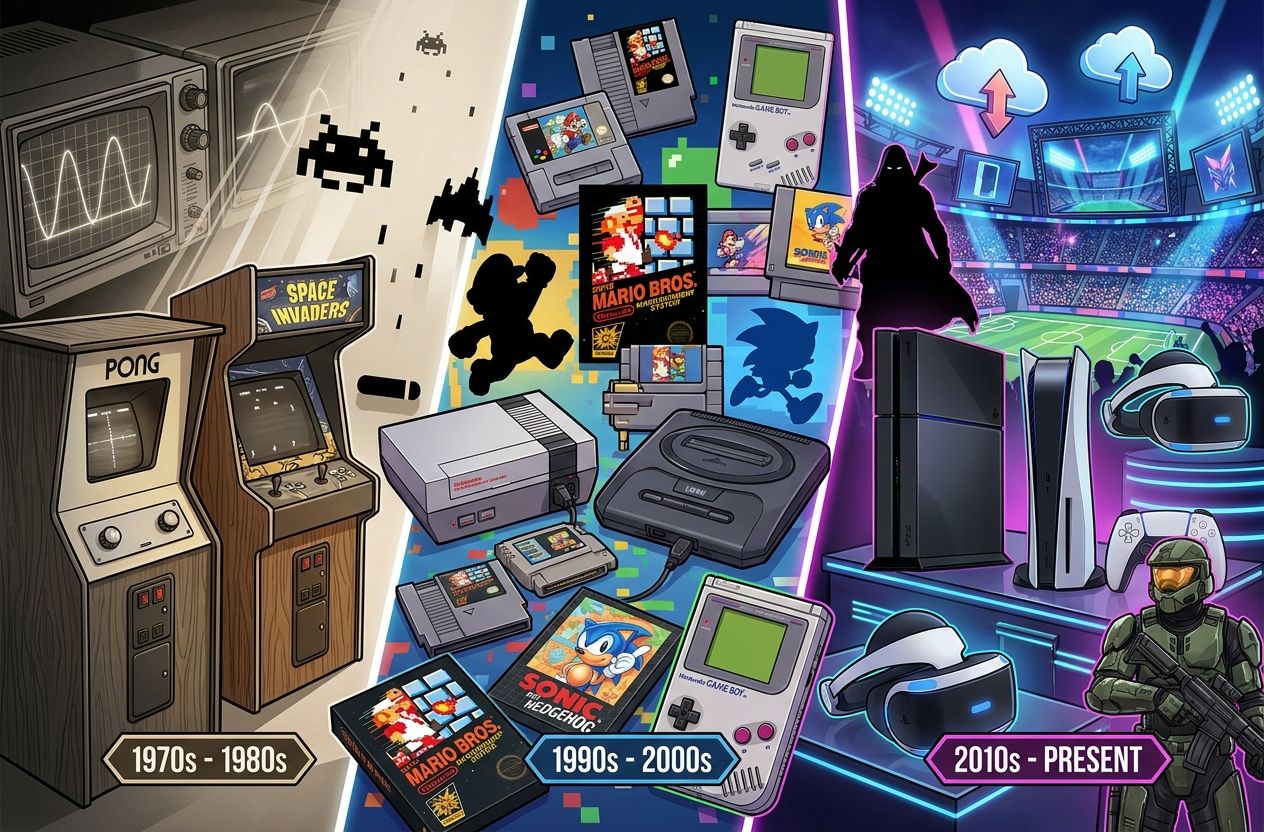
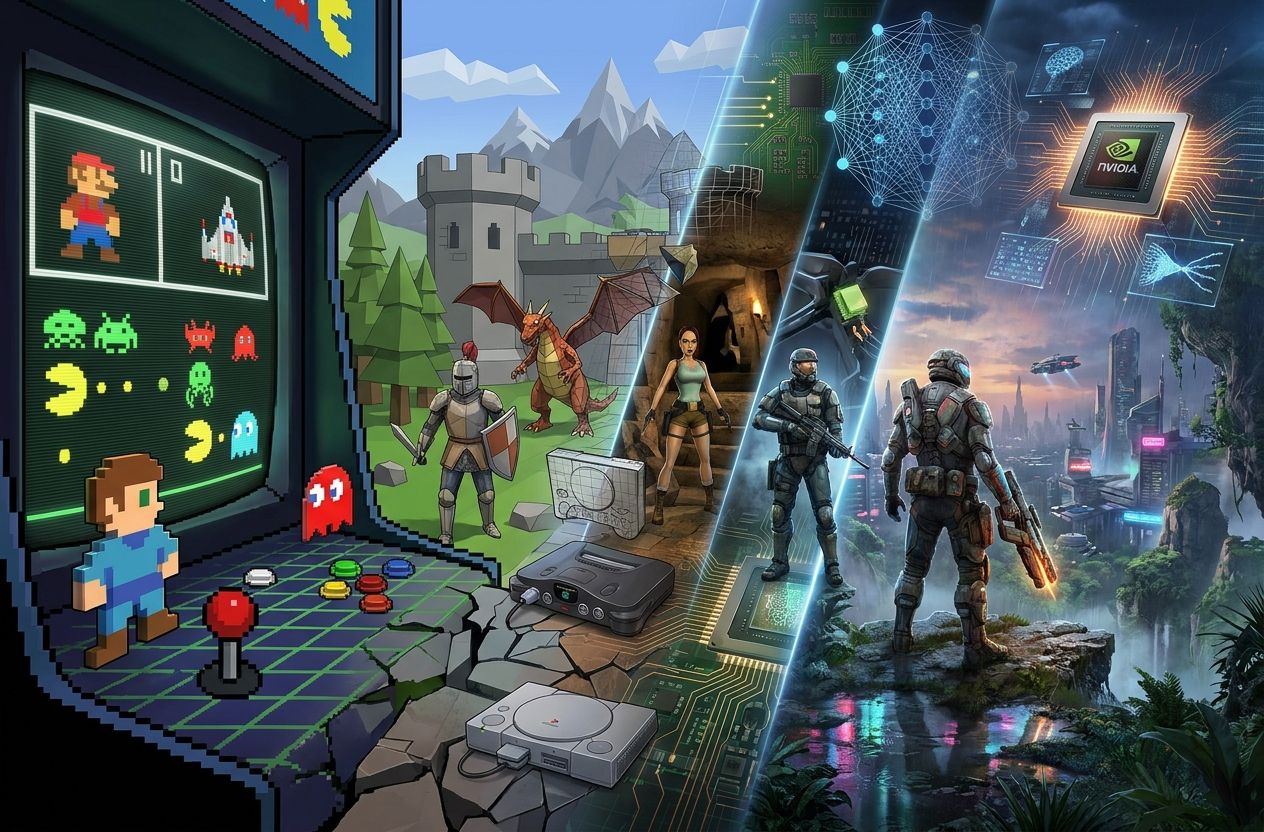
Video game graphics evolution has been one of the defining stories of digital entertainment: from blocky pixels on cathode-ray-tube televisions to near-photorealistic worlds rendered in real time. This article maps the technical milestones, hardware innovations, and rendering advances that shaped the look and feel of video games—and explains how those changes influenced gameplay, immersion, and the industry as a whole.
Why Graphics Matter?
Graphics are more than visual polish. Advances in visual fidelity have historically enabled new gameplay mechanics, deeper immersion, and broader audience reach. As we explore the video game graphics evolution, we’ll see recurring patterns: innovation driven by hardware constraints, software ingenuity that squeezes more performance from limited resources, and a constant interplay between artistic direction and technical capability.
Early Era: Pixels, Sprites, and the Birth of Style (1970s–1980s)
The first era of consumer video games relied on low-resolution displays and extremely limited memory and processing power. Developers worked with a handful of colors and tiny sprite sheets, which led to the birth of pixel art and iconic visual styles.
- Arcade and 8-bit consoles: Games like Space Invaders, Pac-Man, and the Nintendo Entertainment System (NES) classics emphasized readable silhouettes and bold color contrasts.
- Technical constraints: Developers optimized for tile-based rendering, palette swapping, and sprite multiplexing to maximize on-screen action.
Why pixel art endured?
Beyond technological necessity, pixel art evolved into an aesthetic. Many modern indie titles deliberately use pixel visuals to evoke nostalgia and strong readability.
The Transition to 3D: Polygons, Textures, and New Perspectives (1990s)
The 1990s were dominated by the move from 2D sprites to 3D polygonal rendering. Key breakthroughs included hardware-accelerated 3D transforms, texture mapping, and new input paradigms for navigation in three-dimensional space.
- Key milestones: The introduction of GPUs and consoles like the Sony PlayStation and Sega Saturn popularized low-polygon 3D characters and environments.
- Textures and mipmapping: Texture maps added surface detail without exponentially increasing polygon counts. Mipmapping reduced aliasing and improved performance.
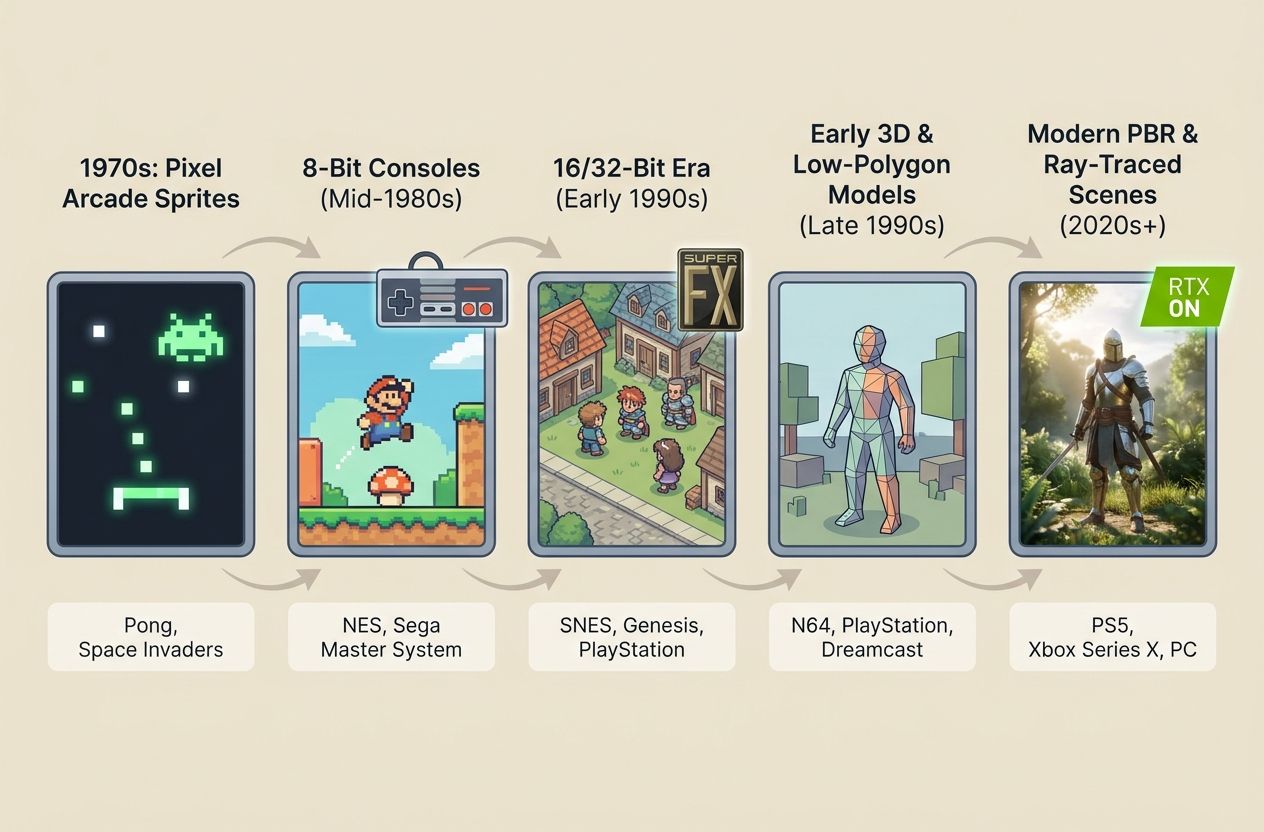
During this period, developers balanced geometric simplicity with clever art direction and animation to convey personality and depth despite technical limits.
Rendering Techniques That Shaped Realism (2000s–2010s)
As GPUs became more powerful, new rendering techniques pushed realism forward. Several innovations stand out:
- Shaders: Programmable vertex and pixel shaders enabled per-pixel lighting, custom materials, and complex visual effects. Shader languages (HLSL, GLSL) unlocked unprecedented artistic control.
- Normal mapping and bump mapping: These techniques simulate surface detail on low-polygon models by altering lighting calculations, creating the illusion of complexity without heavy geometry.
- Physically Based Rendering (PBR): PBR brought consistent, physically plausible materials and lighting models to real-time graphics, making surfaces look believable under diverse lighting conditions. See Unity’s and Unreal Engine’s PBR documentation for practical implementations (Unity PBR, Unreal Engine PBR).
Hardware Innovations: GPUs, Consoles, and Parallelism
Graphics Processing Units (GPUs) were central to the visual leap. GPUs transitioned from fixed-function pipelines to massively parallel programmable processors, enabling sophisticated shading, compute workloads, and complex scene rendering.
Console generations pushed both architecture and developer tools. Modern consoles pair powerful GPUs with custom APIs and middleware to optimize rendering pipelines, streaming, and memory management.
- Memory and bandwidth: Faster VRAM and memory architectures allowed higher-resolution textures and larger scenes.
- Parallel compute: GPU compute cores now handle physics, animation skinning, and even AI-driven visual tasks.
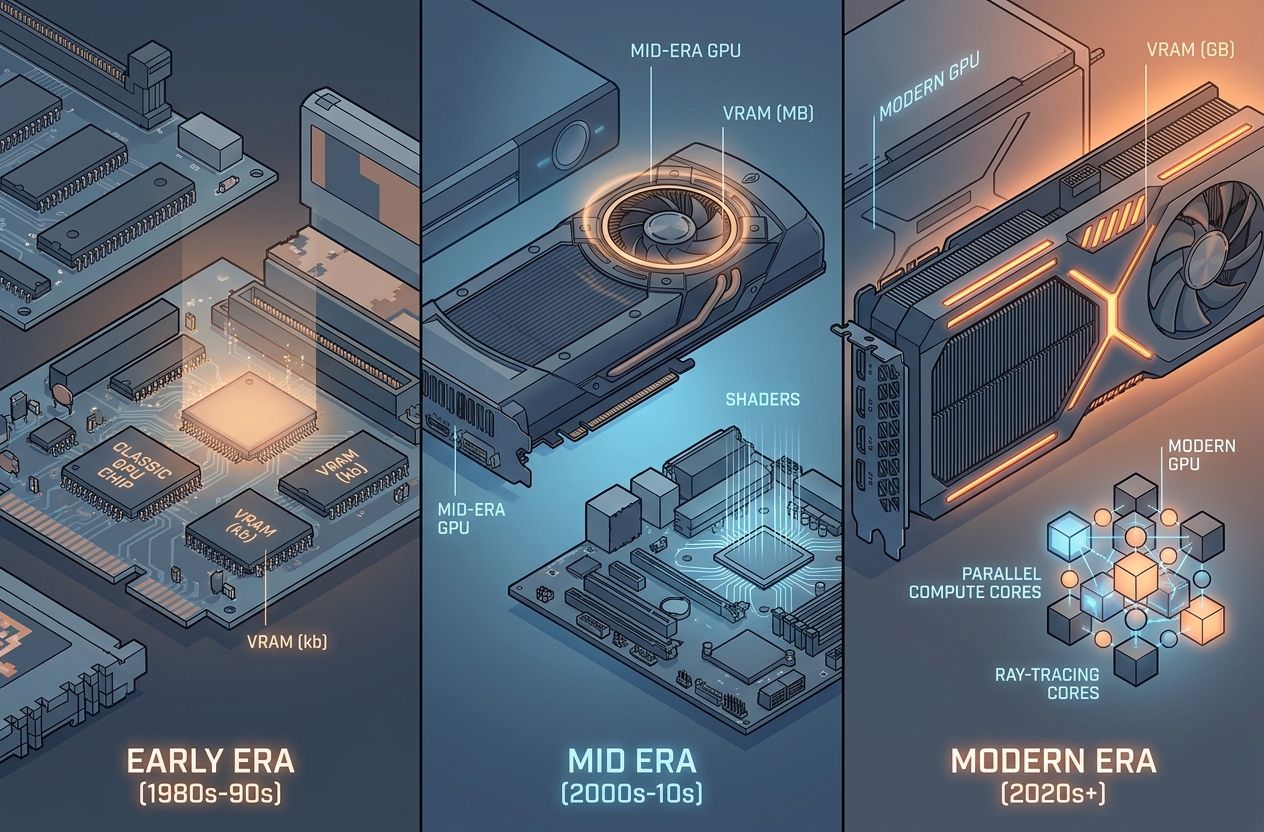
Leading vendors like NVIDIA and AMD continually innovate with architectures that prioritize throughput and energy efficiency.
Real-Time Ray Tracing and the Quest for Photorealism (2010s–Present)
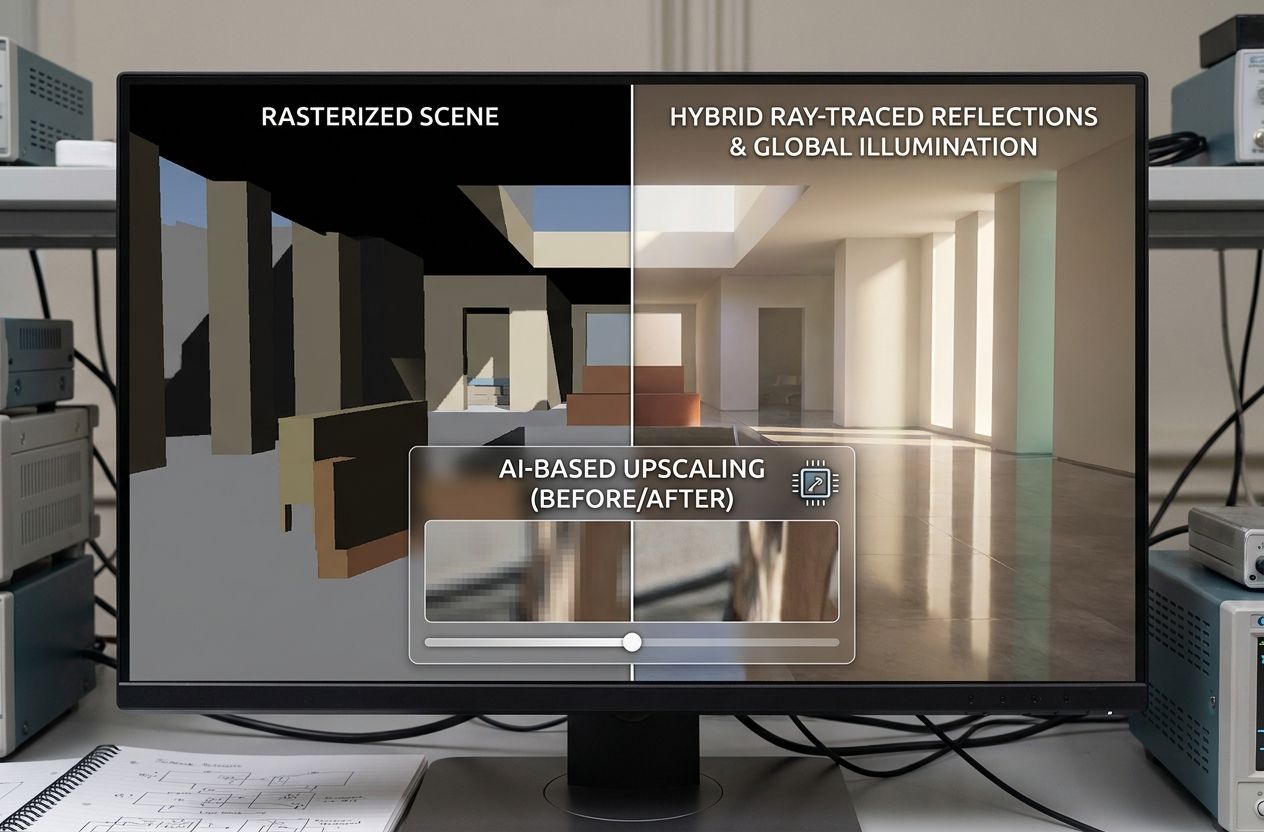
Real-time ray tracing represents a paradigm shift. Traditional rasterization approximates lighting; ray tracing simulates light paths, producing accurate reflections, refractions, and soft shadows. Hardware-accelerated ray tracing (e.g., NVIDIA RTX series) and APIs such as DirectX Raytracing (DXR) enabled this tech to enter real-time games.
Complementary techniques—screen-space reflections (SSR), ambient occlusion, and global illumination approximations—help bridge the gap between rasterization and full ray tracing for performance-sensitive applications.
Major titles and engines now leverage hybrid approaches: rasterization for primary visibility and ray tracing for selective effects like reflections and global illumination.
AI, Upscaling, and Neural Rendering
Recent years have seen AI-driven upscaling and denoising become mainstream. Technologies like NVIDIA’s DLSS (Deep Learning Super Sampling) and AMD’s FSR (FidelityFX Super Resolution) use neural networks or intelligent reconstruction to produce high-resolution frames while rendering fewer pixels, significantly boosting performance.
Neural rendering experiments explore novel workflows: synthesizing content, accelerating character animation, and enhancing textures through machine learning.
Impact on Gameplay, Immersion, and Design
Graphics evolution has tangible effects beyond aesthetics:
- Gameplay mechanics: Improved visuals enable mechanics that rely on spatial fidelity—realistic occlusion for stealth games, accurate physics for simulation titles, and visual clarity for competitive esports.
- Immersion: Enhanced lighting, high-resolution textures, and believable character animation deepen player engagement and emotional resonance.
- Design trade-offs: Higher fidelity can demand more resources. Designers must balance visual ambition with performance, accessibility, and artistic direction.
Tools and Engines Powering the Evolution
Game engines abstract complex rendering pipelines and expose high-level tools. Unreal Engine and Unity accelerated adoption of advanced rendering features like PBR, global illumination, and post-processing stacks. Middleware—renderers, texture tools, and asset pipelines—also advanced, enabling teams to focus on gameplay and art direction.
Case Studies: Milestone Titles
- Early 3D (e.g., Super Mario 64): Demonstrated how 3D environments and camera control could redefine platforming gameplay.
- Photo-real pushes (e.g., The Last of Us Part II): Combined high-fidelity assets, advanced animation, and careful lighting to deliver cinematic realism.
- Real-time ray tracing showcases (e.g., Metro Exodus): Highlighted how ray-traced lighting can dramatically change atmosphere and material realism.
Current Challenges and Practical Considerations
Despite immense progress, developers face ongoing challenges:
- Performance vs. fidelity: Achieving photorealism at steady frame rates across hardware tiers requires optimizations: LODs, occlusion culling, and hybrid rendering.
- Production costs: High-fidelity assets demand time and budget. Procedural generation and runtime authoring tools help reduce manual workload.
- Accessibility and scalability: Designers must ensure that visual improvements don’t exclude players on lower-end hardware or create unfair competitive advantages.
The Future: Beyond Photorealism
What comes after photorealism? Several converging trends suggest possibilities:
- Neural rendering: Real-time generative techniques may synthesize complex scene elements, compressing asset size and reducing manual labor.
- Full path-traced real-time engines: As hardware and algorithms improve, full path tracing could become a mainstream option for some genres.
- Cloud rendering and streaming: Offloading rendering to powerful remote servers enables high-fidelity experiences on lightweight devices. Services like Google Stadia and NVIDIA GeForce NOW point to this direction.
- Procedural worlds and content scaling: Improved procedural tools combined with AI can create vast, varied environments without linear production costs.
These advances will also spur new artistic directions—stylized realism, dynamic storytelling, and interactive cinematics that leverage real-time rendering.
Practical Advice for Developers and Students
For those learning or building games today, focus on fundamentals and practical techniques:
- Master core rendering concepts: rasterization, shading models, and lighting.
- Learn a modern engine: Unreal or Unity and their graphics pipelines.
- Study optimization strategies: LODs, occlusion culling, and efficient asset streaming.
- Experiment with PBR materials, normal maps, and shader authoring.
- Follow research and vendor docs for ray tracing, DLSS, and related tech (see NVIDIA Research and NVIDIA RTX).
Conclusion
The video game graphics evolution is a story of innovation, constraints, and creative solutions. From rudimentary pixels to sophisticated real-time rendering pipelines, each technological leap expanded what games could be and how they could make players feel. As hardware, AI, and cloud technologies continue to evolve, the next decade promises even more dramatic changes—richer worlds, smarter tools, and novel forms of interactive storytelling.
Whether you’re a gamer, developer, or student of game design, understanding this history and the technical trends behind it will help you appreciate not just how games look, but why they look that way—and where they’re headed.