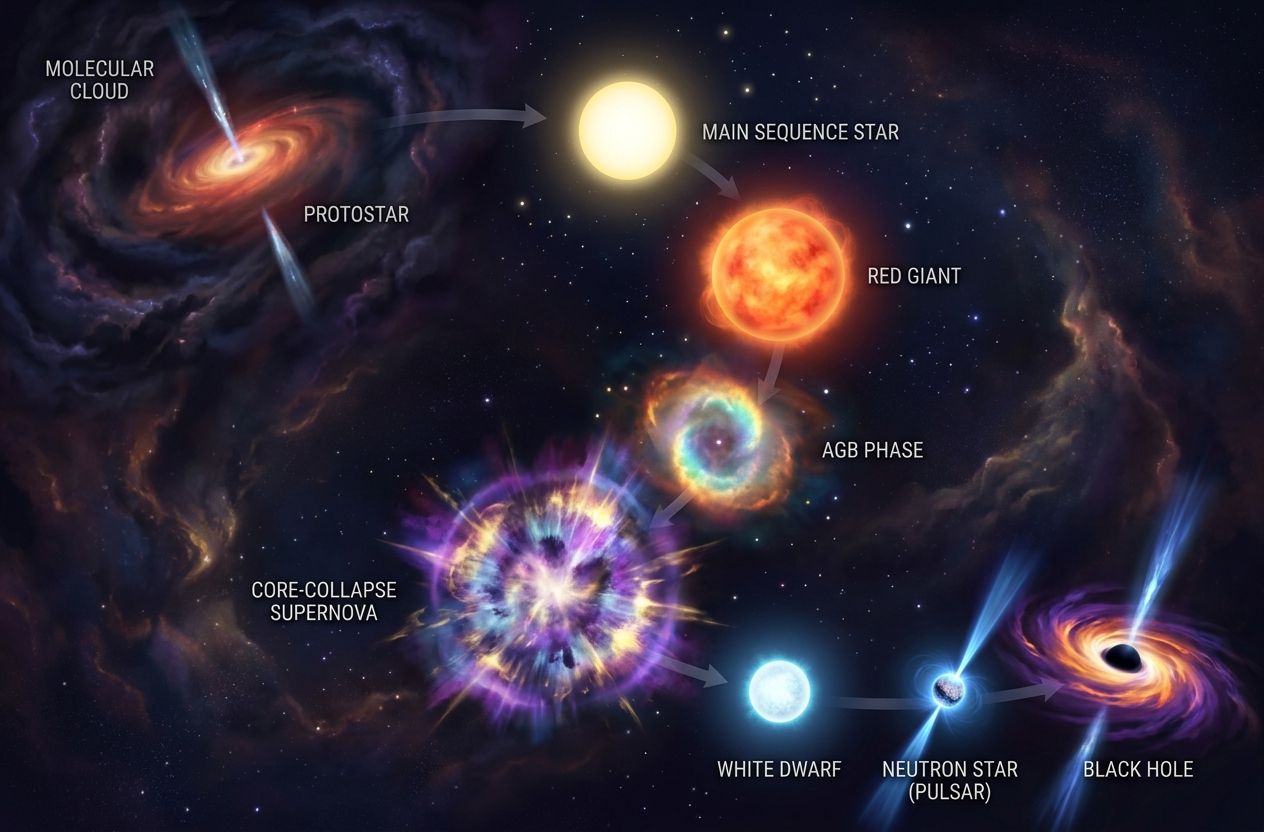
Evolution of stars begins in the cold, dense regions of interstellar clouds and proceeds through distinct physical phases driven by gravity, nuclear fusion and mass. Understanding this life cycle is essential to grasp how the elements that make planets—and life—are produced and distributed across the cosmos.
Why the evolution of stars matters?
The evolutionary pathways of stars determine not only their luminosity, size and lifetime, but also the chemical enrichment of galaxies. Stars forge heavy elements through nuclear reactions (a process called stellar nucleosynthesis) and return material to the interstellar medium via winds and explosive deaths. For educators and students, the study of stellar evolution connects physics, chemistry and cosmology in a coherent narrative that explains how the universe changes over time.
The birthplace: Molecular clouds and protostars
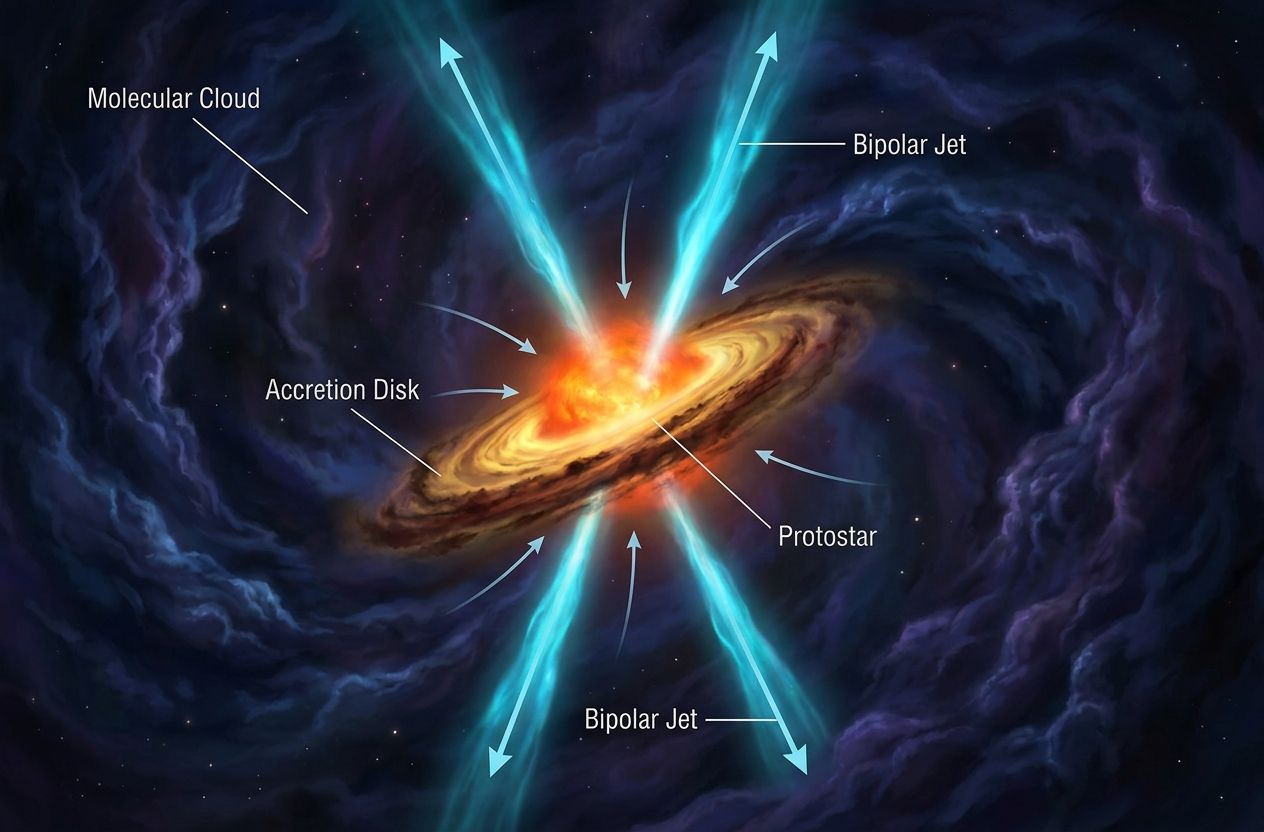
Stars originate in molecular clouds—cold, dense regions of gas and dust within galaxies. Local density enhancements caused by turbulence, nearby supernova shocks or spiral-arm compression can trigger gravitational collapse. As a cloud fragment contracts, it forms a protostar: a dense, hot core surrounded by an accretion disk where material spirals inward.
Key processes during protostar formation
- Gravitational collapse: Gravity overcomes thermal pressure, causing the core to contract.
- Conservation of angular momentum: Leads to formation of an accretion disk and often bipolar jets.
- Heating: Compressional heating raises the core temperature until nuclear reactions can ignite.
Protostellar evolution is rapid on astronomical timescales—typically a few hundred thousand to a few million years—until central temperatures reach millions of kelvin and hydrogen fusion begins.
Main-sequence: The long, stable life
When hydrogen fusion ignites in the core, a star enters the main sequence—the longest phase of stellar life. During this stage, hydrogen is converted to helium through nuclear fusion, releasing energy that balances gravitational contraction and provides stable luminosity.
Mass is destiny: how initial mass sets the path
The star’s initial mass is the single most important factor determining its evolution. Broadly:
- Low-mass stars (below ~0.5 solar masses) burn hydrogen slowly and can remain on the main sequence for tens to hundreds of billions of years.
- Sun-like stars (~0.8–8 solar masses) have lifetimes of roughly 10 billion years.
- High-mass stars (above ~8 solar masses) burn their fuel rapidly and only live millions to tens of millions of years.
Other factors—metallicity (the abundance of elements heavier than helium), rotation, magnetic fields and binarity—also influence a star’s structure and eventual fate.
Post-main-sequence evolution: Expanding and cooling
Once hydrogen in the core is exhausted, fusion ceases there and the core contracts. The outer layers expand and cool, and the star moves off the main sequence. How the star continues depends on mass.
Low and intermediate-mass stars: red giants and asymptotic giant branch
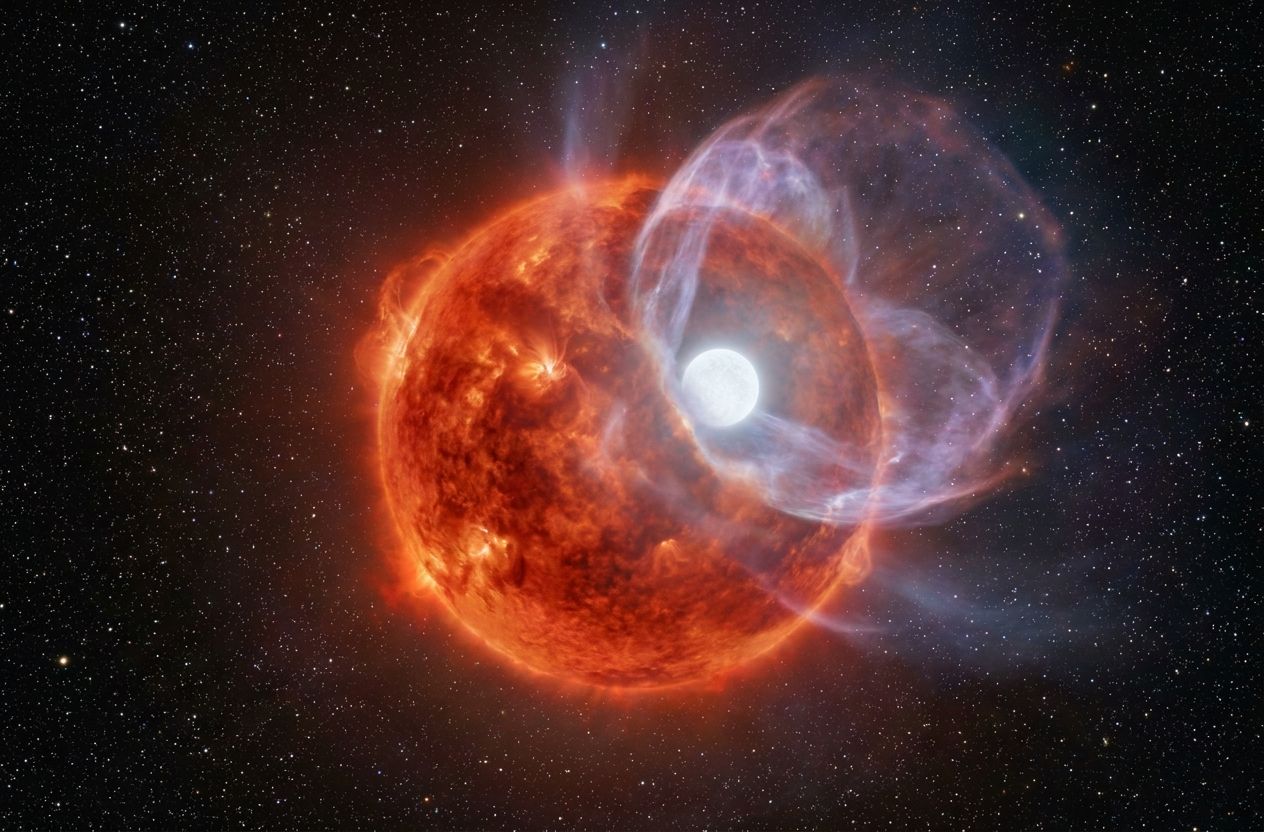
Stars like the Sun become red giants. Their cores contract and heat up until hydrogen fusion continues in a shell around the helium core. Later, helium ignites in the core (the helium flash for some stars), synthesizing carbon and oxygen. Advanced phases include the asymptotic giant branch (AGB), characterized by strong stellar winds that strip the outer layers and enrich the interstellar medium with heavier elements and dust.
High-mass stars: supergiants and heavy-element fusion
Massive stars evolve into supergiants and can fuse progressively heavier elements in successive shells: helium, carbon, neon, oxygen and silicon, eventually forming an iron core. Fusion beyond iron consumes energy, so once an iron core forms, the star faces catastrophic collapse.
The dramatic ends: white dwarfs, neutron stars and black holes
Stellar end states reflect the balance between core mass and the forces able to support it. The main outcomes are:
- White dwarfs: Remnants of low and intermediate-mass stars (up to ~8–10 solar masses). After shedding outer layers as a planetary nebula, the hot core remains as a carbon-oxygen white dwarf supported by electron degeneracy pressure. These objects cool over billions of years.
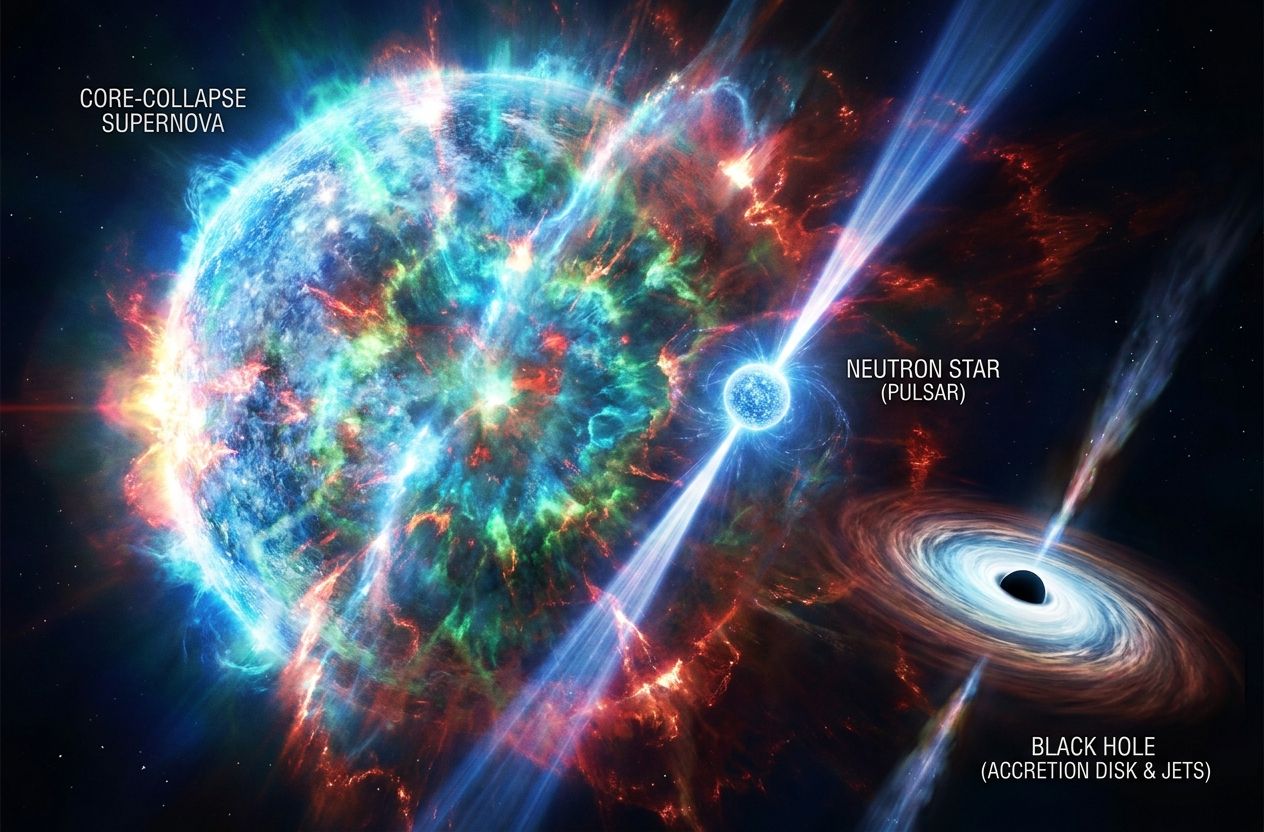
- Neutron stars: Formed when the core of a massive star collapses in a supernova and protons and electrons fuse into neutrons; the result is an incredibly dense object supported by neutron degeneracy pressure. Pulsars—rapidly rotating neutron stars—are one observable outcome.
- Black holes: If the remnant core mass exceeds the maximum supportable by neutron degeneracy (~2–3 solar masses, the Tolman–Oppenheimer–Volkoff limit is uncertain), gravity overwhelms all known forms of pressure and a black hole forms.
Supernovae, especially core-collapse supernovae from massive stars, are critical: they distribute heavy elements into space and can trigger star formation in surrounding clouds. For more on supernovae and remnants, see NASA: Supernova.
Special outcomes and exotic channels
Binary interactions
Many stars are in binary or multiple systems. Mass transfer, common-envelope evolution and mergers produce outcomes like Type Ia supernovae (thermonuclear explosions of white dwarfs) or blue stragglers in clusters. These channels complicate the simple mass-based picture and are crucial for chemical yields and transient astronomy.
Stellar collisions and mergers
In dense environments (globular clusters, galactic centers), collisions or mergers can form unusually massive stars, lead to gravitational-wave sources (merging neutron stars or black holes) and produce short-lived exotic phenomena. The detection of gravitational waves from compact object mergers has opened new windows into these final stages.
Timescales: comparing lifespans across masses
- Red dwarfs: Up to trillions of years (they burn fuel very efficiently).
- Sun-like stars: ~10 billion years on the main sequence.
- Massive stars: Millions to tens of millions of years—short but spectacular lives.
Why stellar evolution matters for the universe?
Stellar evolution is the engine of chemical evolution. Elements heavier than helium are created in stars and dispersed through winds and supernovae, enabling the formation of rocky planets and life as we know it. The distribution of stellar remnants (white dwarfs, neutron stars, black holes) also affects galaxy dynamics and the sources of high-energy astrophysical phenomena.
For an authoritative overview of stellar evolution theory, see the Stellar evolution entry on Wikipedia and educational resources at NASA Science.
Observational signatures and how we study stellar evolution
Astronomers use multiple tools to reconstruct stellar life cycles:
- Spectroscopy to determine composition, temperature and motion.
- Photometry and light curves to monitor variability, eruptions and transients.
- Asteroseismology to probe internal structure through stellar oscillations.
- Infrared and radio observations to peer into dusty star-forming regions.
Combining theoretical models with observations of star clusters—where stars share age and initial composition—allows astronomers to test evolutionary tracks and refine models of stellar interiors and nucleosynthesis.
Teaching tips and resources for educators
To teach the evolution of stars effectively:
- Use visual aids like Hertzsprung–Russell diagrams to show how stars move through different stages.
- Compare lifetimes across masses with relatable analogies (e.g., “small candles vs. short-lived torches”).
- Incorporate simulations and interactive tools from NASA, ESA or university astrophysics departments.
Good classroom resources include NASA’s education pages and interactive HR diagram tools. See NASA and the European Space Agency (ESA).
Conclusion: A cosmic cycle of birth, life and death
The evolution of stars is a cornerstone of modern astrophysics. From cold molecular clouds to radiant main-sequence stars, and finally to remnants like white dwarfs, neutron stars and black holes, each stage plays a role in shaping galaxies and producing the chemical elements that make planets and life possible. By studying these processes, students and researchers uncover the narrative of the universe itself.
Further reading: For detailed textbooks, consider “An Introduction to Modern Astrophysics” by Carroll & Ostlie and review articles in Annual Review of Astronomy and Astrophysics.