Black holes are among the most intriguing objects in the cosmos. In this article we will explain, in clear and accessible terms, what a black hole is, how black holes form, the main types, how astronomers detect them, and why they matter for our understanding of the universe.
Introduction
Black holes appear when matter is compressed into an extremely small volume, producing gravity so strong that even light cannot escape. This simple idea hides deep physics: the collapse of massive stars, the warping of spacetime described by General Relativity, and energetic phenomena visible across the electromagnetic spectrum. In the sections that follow we will unpack these concepts step by step and provide examples and reliable sources for further reading.
What is a black hole?
A black hole is a region of spacetime where gravity is so intense that the escape velocity exceeds the speed of light. The boundary beyond which nothing can return is called the event horizon. Inside lies what classical theory calls the singularity, a point (or region) where densities and spacetime curvature become extremely large according to General Relativity.
Important related terms:
- Event horizon — the surface delimiting the black hole.
- Singularity — where classical descriptions break down.
- Schwarzschild radius — the radius of the event horizon for a non-rotating mass (Rs = 2GM/c2).
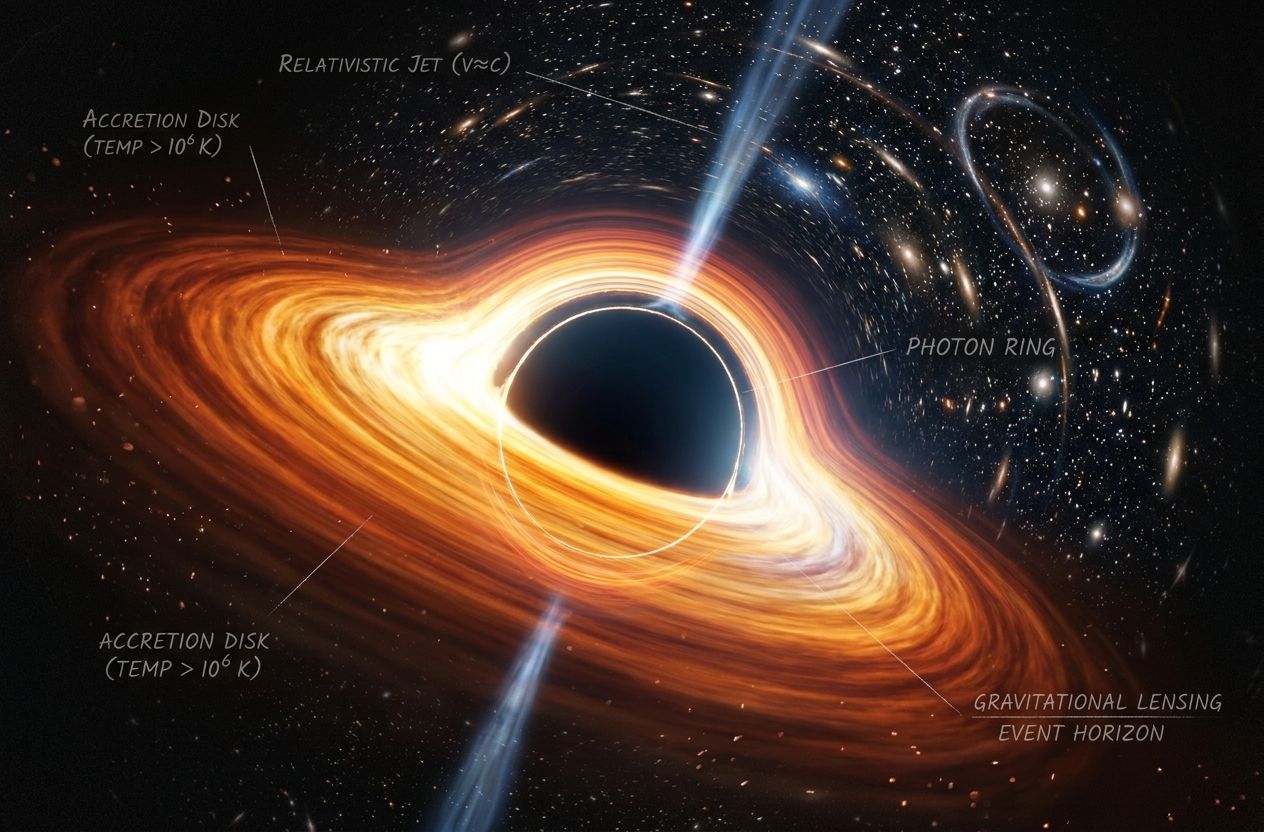
- Accretion disk — hot, luminous gas spiraling into the black hole.
- Relativistic jets — narrow beams of high-energy particles sometimes launched from the vicinity of spinning black holes.
How do black holes form?
There are several formation channels for black holes. The main ones are:
1. Stellar collapse: formation of stellar-mass black holes
When a massive star (typically exceeding about 8 times the mass of the Sun) exhausts its nuclear fuel, it can no longer support itself against gravity. The core collapses. For certain mass ranges, the collapse leads to a supernova explosion and leaves behind a compact remnant. If the remnant mass is above the neutron star limit (Tolman–Oppenheimer–Volkoff limit, roughly 2–3 M☉), the core collapses into a stellar-mass black hole (tens of solar masses).
This process explains many of the black holes detected via X-ray binaries and the merging systems observed by gravitational-wave observatories (e.g., LIGO/Virgo).
2. Direct collapse and formation of massive seeds
Early in the universe, very massive gas clouds could collapse directly into large black hole seeds (104–106 M☉) without first forming stars. These seeds are one possible route to creating the supermassive black holes found at the centers of galaxies.
3. Growth by accretion and mergers
Black holes grow by swallowing gas and by merging with other black holes. Over cosmic time, repeated accretion episodes and coalescences can build up black holes from stellar masses to the supermassive range (millions to billions of solar masses).
4. Primordial black holes (hypothetical)
Some theories predict that small primordial black holes might have formed from density fluctuations in the very early universe (fractions of a second after the Big Bang). These remain hypothetical but are an active area of research because they could contribute to dark matter or seed structure formation.
Key physics: the Schwarzschild radius and essential formulas
The Schwarzschild radius Rs provides a useful scale: Rs = 2GM/c2, where G is the gravitational constant, M is the mass, and c is the speed of light. For the Sun, Rs ≈ 3 kilometers; for a 10 M☉ object, Rs ≈ 30 km.
Although the Schwarzschild radius is derived for non-rotating, uncharged black holes, it gives a sense of how compact an object must be to become a black hole. Rotating black holes are described by the Kerr metric, and charged ones by the Reissner–Nordström metric in General Relativity.
Types of black holes
- Stellar-mass black holes: a few to a few tens of solar masses, formed from collapsing stars.
- Intermediate-mass black holes: hundreds to hundreds of thousands of solar masses; observational evidence is growing but still limited.
- Supermassive black holes: millions to billions of solar masses, found in galactic centers (e.g., the Milky Way’s Sagittarius A*).
- Primordial black holes: hypothetical small black holes formed in the early universe.
Structure around a black hole
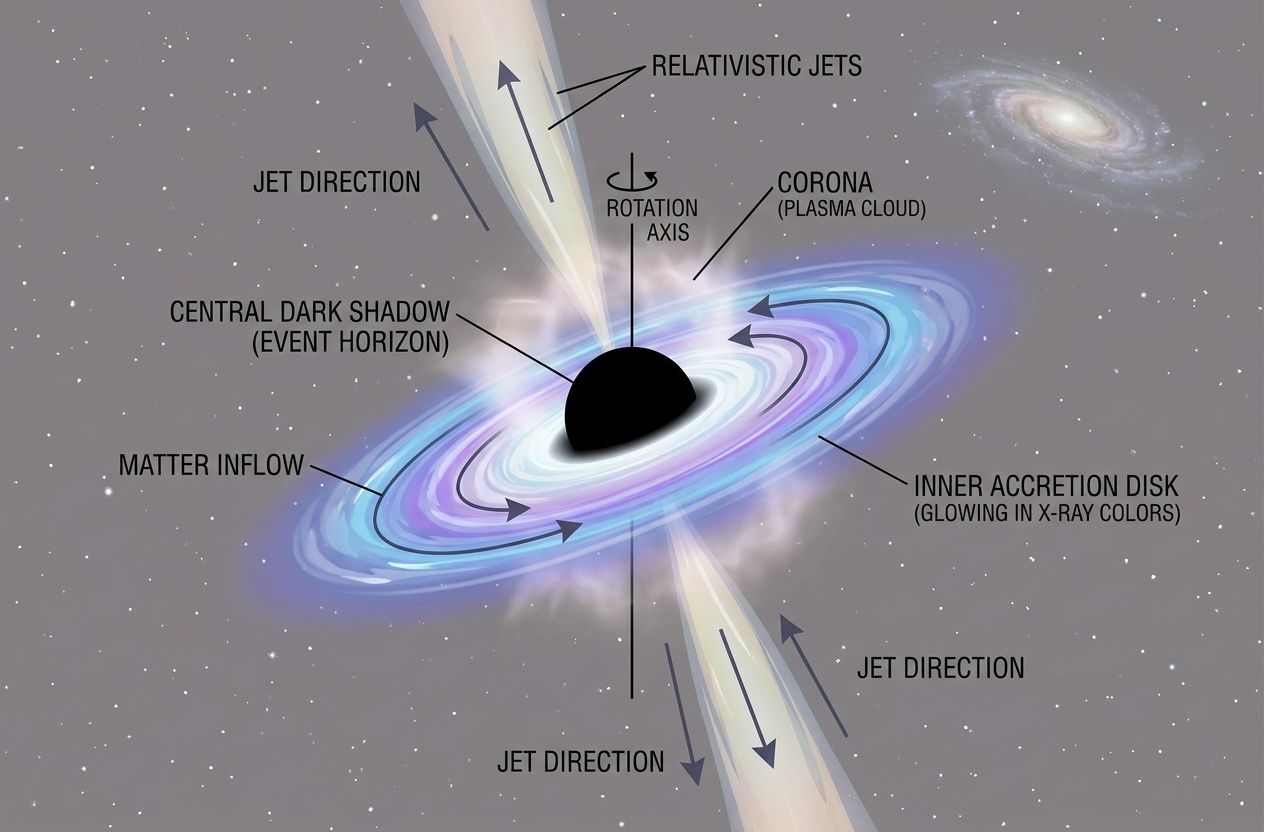
Surrounding a black hole, especially an active one, we often observe:
- Accretion disk: gas heats up and radiates strongly (X-rays, optical) as it spirals inward.
- Corona: hot electron cloud producing high-energy photons.
- Relativistic jets: powered by magnetic fields and rotation in systems like active galactic nuclei (AGNs).
How do we detect black holes?
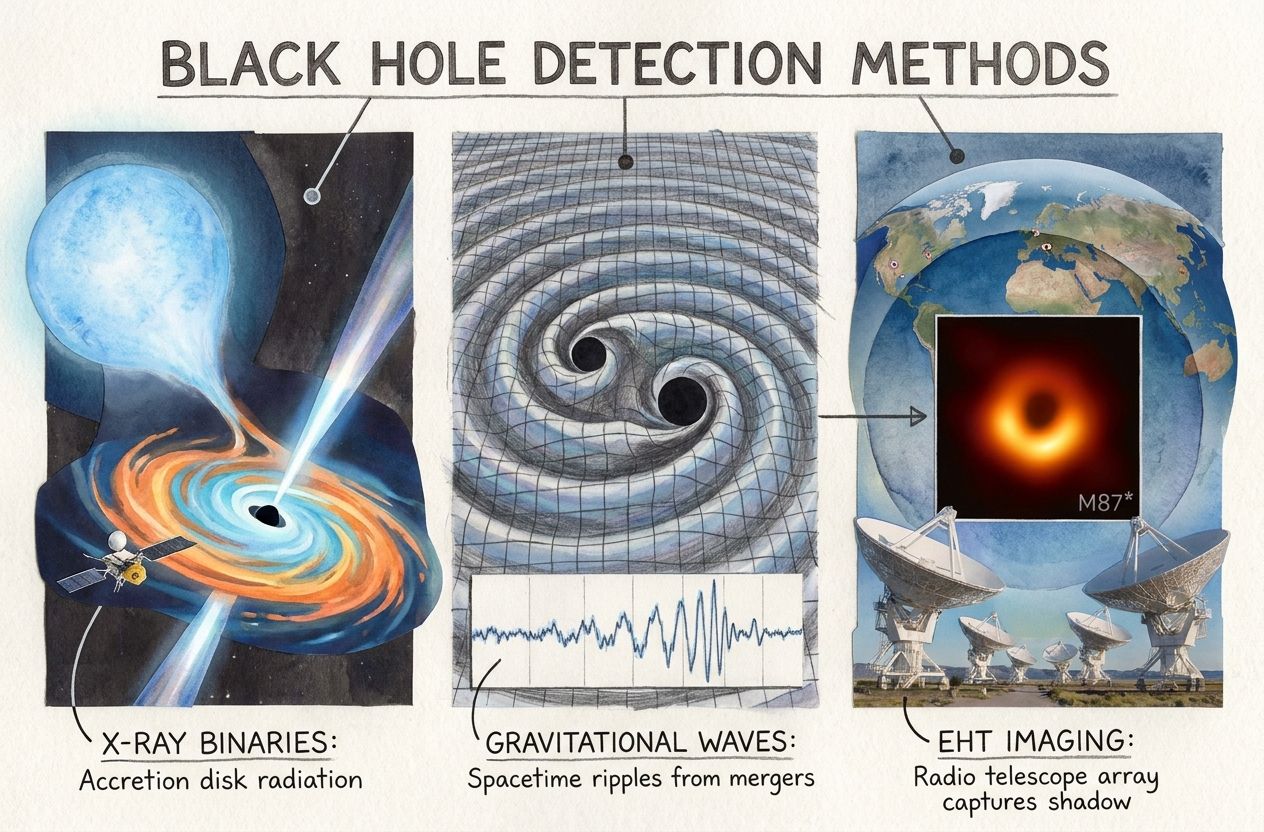
Because black holes emit no light themselves, astronomers infer their presence via indirect signatures:
- Accretion emission: X-rays and other radiation from hot gas in an accretion disk reveal compact, massive objects in X-ray binaries and AGNs. See NASA’s overview: NASA — Black Holes.
- Stellar dynamics: tracking the motion of stars (e.g., stars orbiting Sagittarius A* at the center of the Milky Way) gives precise mass estimates for central black holes. The European Southern Observatory’s observations provide excellent data: ESO — Galactic Center.
- Gravitational waves: mergers of compact objects emit ripples in spacetime, detected by LIGO and Virgo. These confirm the existence of merging black holes: LIGO.
- Imaging the shadow: the Event Horizon Telescope (EHT) produced the first image of a black hole’s shadow in galaxy M87, a milestone for observational astrophysics: EHT.
- Gravitational lensing: black holes can bend light from background objects, producing observable lensing effects.
Why black holes matter for modern astronomy
Black holes are not merely exotic endpoints; they shape galaxies and drive energetic phenomena:
- Galactic evolution: feedback from supermassive black holes (winds, jets) regulates star formation in host galaxies.
- Testing gravity: regions near black holes test General Relativity in the strong-field regime.
- Cosmology and structure formation: black hole seeds and growth influence the early evolution of galaxies.
- Multi-messenger astronomy: combined electromagnetic and gravitational-wave observations open new windows into the universe.
Common misconceptions
- Black holes are cosmic vacuum cleaners: Their gravity is strong near them, but at everyday distances a black hole of the Sun’s mass would attract like the Sun did before it collapsed.
- Everything is instantly destroyed: Tidal effects near small black holes can be extreme, but for large supermassive black holes, tidal forces at the event horizon can be relatively gentle.
- Black holes violate physics: They are solutions of Einstein’s equations. The singularity signals limits of classical GR and points toward a need for quantum gravity.
Milestones in observation
- First gravitational wave detections of merging black holes (LIGO, 2015).
- First direct image of a black hole shadow (EHT, 2019).
- Precise orbits of stars around Sagittarius A* confirming a ~4 million M☉ black hole at our galaxy’s center (ESO and other collaborations).
Frequently asked questions (FAQ)
Can anything escape a black hole?
Once inside the event horizon, classical theory says nothing can escape. However, quantum processes like Hawking radiation predict extremely slow black hole evaporation for small black holes; for astrophysical black holes, this effect is negligible.
How big is a black hole?
Size is measured by the Schwarzschild radius, which scales with mass. Supermassive black holes can have event horizons as large as the solar system; stellar black holes are tens of kilometers across.
Are black holes dangerous to Earth?
Not in any realistic scenario. There are no known black holes on a collision course with Earth. Even if one passed through the solar system, the likelihood and dynamics make catastrophic encounters extremely unlikely.
Further reading and trusted sources
Conclusion
Black holes are powerful probes of fundamental physics and cosmic history. From the dramatic collapse of massive stars to the slow growth of supermassive monsters at the centers of galaxies, black holes reveal the extremes of gravity, energy, and time. Whether you are a student, an astronomy enthusiast, or a science fan, understanding how black holes form and behave opens a window to the most energetic and mysterious processes in the universe.