
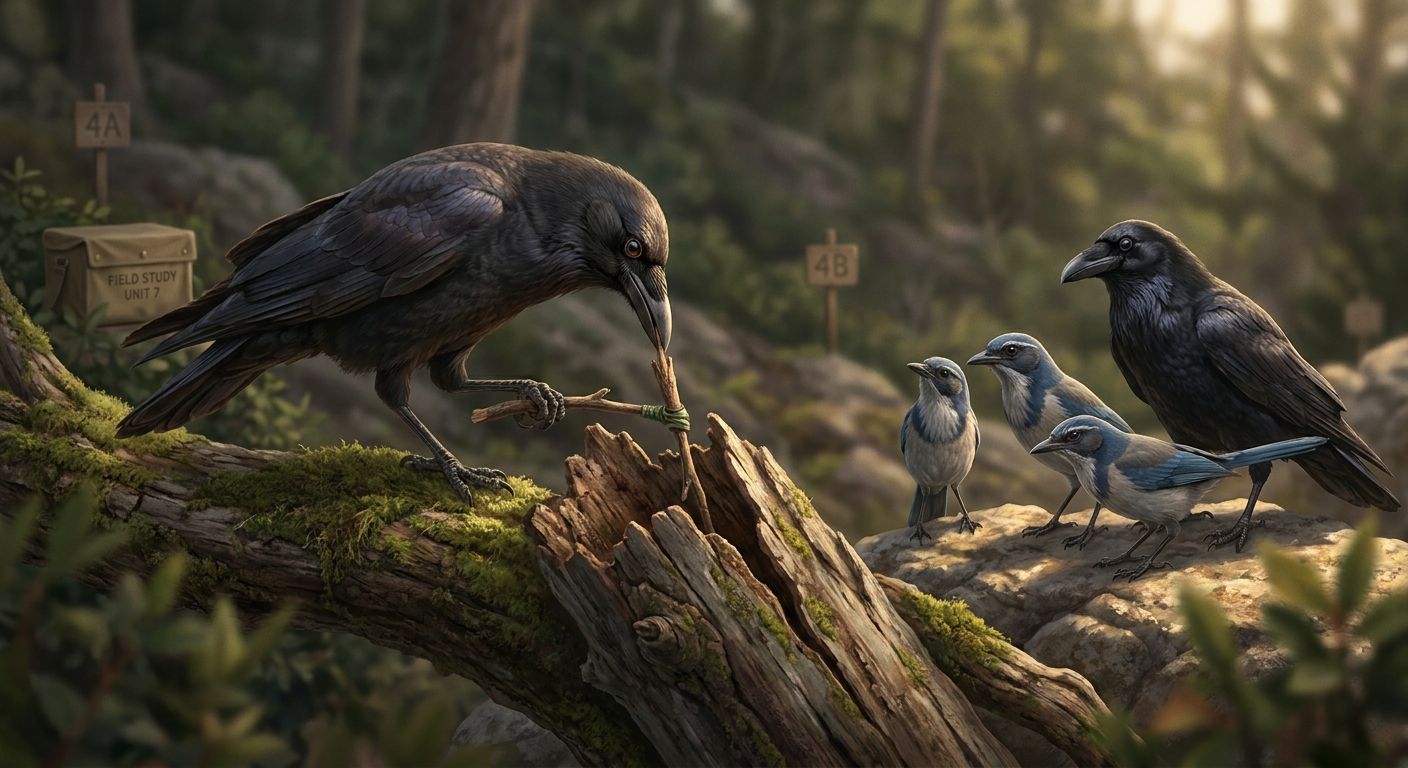
The intelligence of crows is a striking example of complex cognition in birds: this article introduces how corvids use tools, solve multi-step problems, and exhibit advanced social behaviors. This post explores the scientific evidence, classic experiments and real-world observations that show why corvids are models for studying animal intelligence.
Why corvids matter: an overview
Corvids (the bird family that includes crows, ravens, rooks, jackdaws, magpies and jays) display a surprising array of cognitive skills. Research over the last three decades has shifted scientific perspectives: rather than simple instinct-driven animals, corvids demonstrate flexible, creative and context-sensitive behaviors that meet many criteria for advanced cognition.
Key cognitive domains commonly studied in corvids include:
- Tool use and manufacture
- Problem solving and causal reasoning
- Social intelligence, including deception and cooperation
- Memory and planning
- Learning and cultural transmission
Brain and behavioral foundations of crow intelligence
Although corvid brains are smaller than those of many mammals, they are densely packed with neurons, especially in regions analogous to the mammalian forebrain. Studies show that corvids have high neuron counts in the pallium, supporting complex information processing. The combination of high neuron density and specialized circuitry underlies their impressive behavioral repertoire.
Neuroanatomical notes
High neuron density: Research (e.g., Herculano-Houzel and colleagues) has shown that parrots and corvids have neuron densities comparable to primates relative to brain size. This likely contributes to rapid processing, working memory capacity and behavioral flexibility.
Tool use and manufacture: classic demonstrations
One of the most vivid demonstrations of corvid intelligence is tool use. New Caledonian crows fashion and use hooks and probes to extract insects from crevices—behavior once thought to be unique to humans and some primates. The foundational field observations by researchers such as Christian R. Hunt and later controlled experiments have provided robust evidence for tool manufacture and modification.
Notable experiments:
- Tool manufacture and shaping: New Caledonian crows create hooked tools from twigs and leaf stems to extract prey.
- Sequential tool use: In captive experiments, some corvids use a series of tools in succession to reach food, showing planning and goal-directed behavior.
For a readable overview of field discoveries, see the BBC summary of New Caledonian crow research. For academic context, many original reports and reviews are available in Nature and Science journals.
Problem solving and causal reasoning
Corvids excel at tasks that require reasoning about cause and effect. The famous “Aesop’s Fable” paradigm (dropping stones in water to raise a floating food reward) has been used with rooks and New Caledonian crows. These birds learn to prefer sinking objects and to discriminate between functional and non-functional materials—an indication of intuitive causal understanding rather than mere trial-and-error learning.
Examples of experimental findings:
- Rooks quickly learn to drop stones to raise water level and retrieve a reward.
- Some corvids will choose tools or materials based on weight and displacement, showing sensitivity to physical properties.
- When tasks require multi-step strategies, corvids can plan sequences of actions rather than acting reflexively.
Social intelligence: culture, deception and communication
Corvids are highly social and their interactions reveal nuanced social cognition.
Cache protection and theory of mind-like behavior
Food caching species (e.g., scrub-jays) exhibit behaviors suggesting they can anticipate what other birds know or intend. When observed while caching, some jays will later move their caches to new locations after observers leave—an apparent attempt to protect stored food from thieves. This has been interpreted as evidence for perspective-taking or at least sophisticated social monitoring. See Clayton & Dickinson’s research on episodic-like memory and cache protection for detailed experiments: Nature.
Deception and strategic behavior
Ravens and crows may use deceptive tactics, such as fake caching or waiting until potential competitors are distracted before retrieving food. These behaviors indicate an ability to adjust strategies according to social context.
Memory, planning and future cognition
Several corvid species show strong memories for cache locations, retention intervals, and even the content of caches (for species that prefer certain foods). Perhaps most surprising is evidence that some corvids can plan for future needs—choosing tools or hiding food in ways that benefit them later. While debates persist about whether this equals human-like planning, the data support advanced temporal cognition in corvids.
Comparisons with other species: how corvids stack up
Comparative studies highlight convergent evolution of intelligence: corvids and primates often arrive at similar cognitive outcomes via different neural architectures. Rather than ranking species by raw IQ, researchers compare task performance, flexibility, and ecological relevance of skills.
Key comparative points:
- In tool use tasks, some corvids match or exceed many non-human primates in speed and creativity.
- Social cognition in corvids (e.g., deception, cache-protection) rivals that seen in chimpanzees for functionally similar behaviors.
- Memory performance (especially spatial memory for caches) can surpass many mammals and is highly adapted to the bird’s ecology.
Case studies and memorable examples
New Caledonian crows
Renowned for tool manufacture, New Caledonian crows produce hooked tools and show innovation when standard tools do not work. Laboratory work shows they can modify tools to fit problems—an important signature of causal understanding.
California scrub-jays
Scrub-jays display episodic-like memory: they remember what they cached, where, and when. Experiments show they retrieve perishable foods sooner than non-perishable items, demonstrating memory tied to future outcomes and preferences.
Ravens and social intelligence
Ravens form complex social bonds, cooperate in play and problem-solving, and show tactical behaviors like recruitment and food-sharing under some conditions—reflecting flexible social strategies.
Methodological notes: how scientists study crow intelligence
Researchers combine field observations, controlled lab experiments and comparative analyses. Common methods include puzzle boxes, tool-use challenges, caching experiments, and neuroanatomical studies. Ethical considerations and ecological validity are crucial: laboratory tasks must avoid anthropocentric biases and account for species-specific motivation.
Implications for animal cognition, conservation and human understanding
Studying the intelligence of crows has broad implications:
- Evolutionary biology: examples of convergent evolution where birds and mammals develop similar cognitive skills for similar ecological problems.
- Animal welfare and conservation: recognizing complex cognition can influence conservation priorities and captive care standards.
- Robotics and AI: insights into efficient problem-solving and distributed cognition inspire algorithms and biomimetic designs.
For conservation context and public engagement, see resources from organizations such as the Cornell Lab of Ornithology: Cornell Lab of Ornithology.
Frequently asked questions (FAQ)
Can crows really plan for the future?
Evidence suggests some corvids can make choices that benefit future outcomes (e.g., selecting tools to use later). While debates continue about the underlying cognitive mechanisms, these behaviors show more complex temporal cognition than previously assumed.
Are crows as smart as primates?
Direct comparisons are difficult because of different sensorimotor systems and ecologies. However, corvids match or exceed primates on many tasks, especially those relevant to their lives, demonstrating convergent cognitive sophistication.
Do all crows show the same intelligence?
There is variation between species. New Caledonian crows and scrub-jays are often highlighted for tool use and memory, respectively. Environment, social structure and ecological demands shape the expression of intelligence.
Practical tips for students and enthusiasts
- Read primary literature and reviews: search Google Scholar for terms like “New Caledonian crow tool use” or “scrub-jay episodic memory.”
- Observe local corvids ethically: take field notes on problem-solving or caching behaviors while minimizing disturbance.
- Follow reputable labs and institutions for updates: e.g., Nature, Science, and university research pages.
Selected references and further reading
- Hunt, G. R. (1996). Manufacture and use of hook-tools by New Caledonian crows. Nature. (See summaries at major outlets such as BBC)
- Clayton, N. S., & Dickinson, A. (1998). Episodic-like memory in scrub-jays. Nature.
- Emery, N. J., & Clayton, N. S. (2004). The mentality of crows: convergent evolution of intelligence in corvids and apes. Science.
- Herculano-Houzel, S. (various). Work on neuron counts in bird brains and implications for cognition.
For students and curious readers, this synthesis provides a starting point for exploring primary studies and observing corvid intelligence in the field. Recognizing the cognitive lives of birds fosters appreciation and supports conservation efforts for these remarkable animals.
Conclusions
The study of the intelligence of crows reveals a complex, flexible and context-sensitive animal mind. From tool manufacture to social strategy and memory, corvids challenge our assumptions about the distribution of intelligence across the animal kingdom. Continued research, grounded in ethical fieldwork and creative experiments, will deepen our understanding of how diverse brains solve life’s problems.