Birds with false nest entrances are a striking example of behavioral adaptation: by creating decoy openings or maze-like approaches, some species reduce predation risk and increase the survival chances of their young. In this article I explain the reasons behind this strategy, compare different species that use decoy entrances, and highlight research and observations useful for birdwatchers and students of animal behavior.
What are false nest entrances?
False nest entrances (also called decoy entrances, dummy entrances, or deceptive openings) refer to architectural features deliberately built by birds that resemble a real nest entrance but do not lead to the actual nesting chamber. These structures can vary from an alternate hole to an elaborate tunnel that appears usable but ends in a sealed cavity.
Why do birds build false nest entrances? Main defensive functions
Several complementary hypotheses explain why some species invest energy in building false entrances. Most center on reducing predation and parasitism, but also include benefits related to brood parasitism avoidance, heat regulation, and mate signaling.
1. Predator confusion and distraction
The most accepted function is defensive: a decoy entrance can divert predators away from the true nest chamber. Predators such as snakes, rodents, and some birds hunt by locating the opening of a nest. When presented with multiple apparent entries, a predator’s search time increases and its success rate often drops.
2. Increased time-to-access
Even if a predator investigates the nest, false entrances add obstacles—dead-end tunnels, angled passages, or concealed chambers—that increase the time predators need to reach eggs or chicks. This added time can be critical, giving parents the opportunity to mob, alarm, or relocate the brood in some cases.
3. Protection from brood parasites
Some birds face threats from brood parasites (species that lay eggs in other birds’ nests). Decoy entrances make it harder for parasites to quickly deposit eggs unnoticed. While brood parasitism is not the main driver in every species that builds false entrances, it can be a secondary benefit.
4. Thermoregulation and microclimate control
In a few cases, architectural complexity—like extended tunnels—can create more stable microclimates for eggs and nestlings. False entrances can help buffer temperature changes and reduce wind or rain intrusion while maintaining a hidden real chamber.
Well-known species and case studies
Below are notable examples of species known or strongly suspected to build false entrances, with descriptions of how they implement the strategy.
Penduline tits (Remiz species)
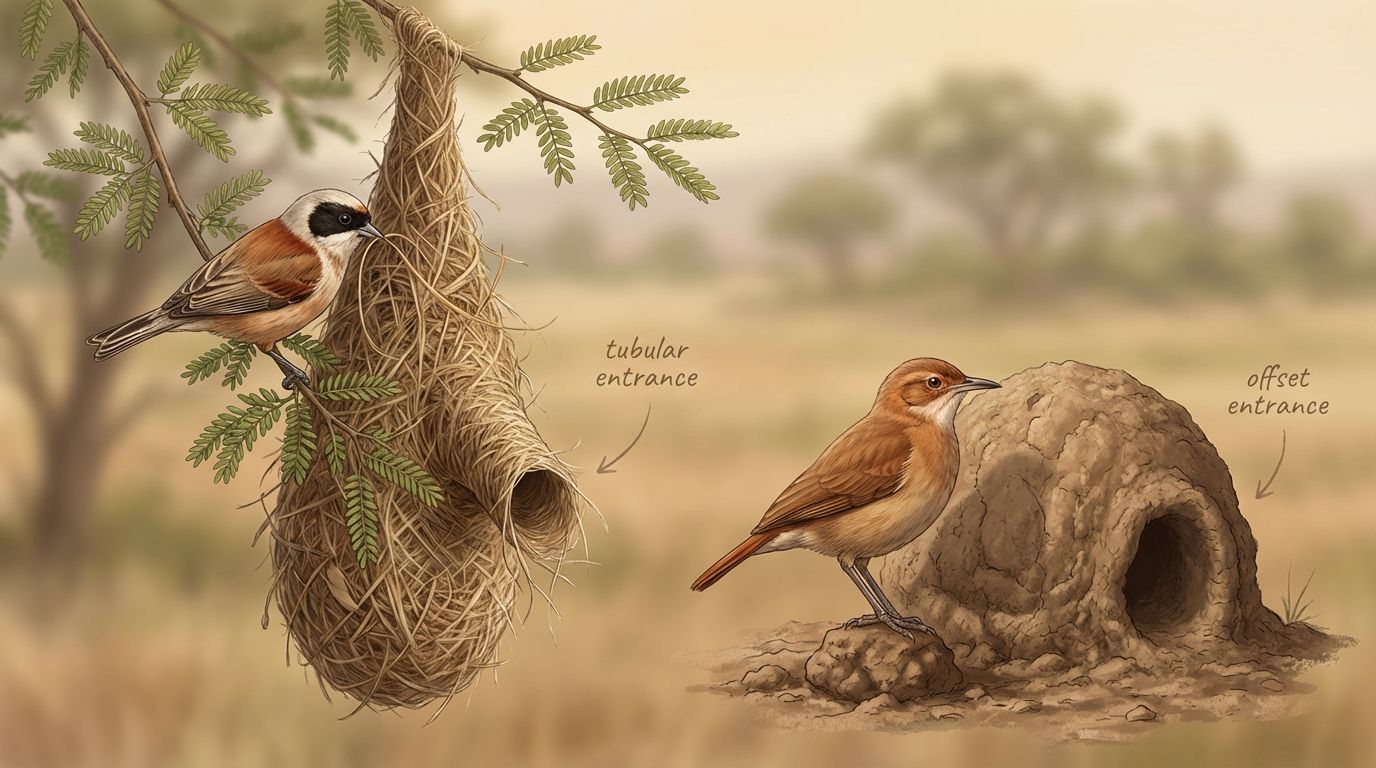
The penduline tit (often referred to in Europe as the penduline tit) builds ornate, hanging nests with tubular entrances. Some species construct an apparent tunnel or elongated entrance that misleads predators. These nests are typically suspended from branches and lined with soft material. The long entrance can be angled or partially plugged so that predators are less likely to reach the true nesting chamber quickly.
Rufous hornero (Furnarius rufus) — the joão-de-barro
The South American joão-de-barro, commonly called the rufous hornero, constructs sturdy oven-like nests of mud. These nests often have entrances placed in ways that make the internal chamber less visible; some hornero nests include a short tunnel or an offset opening that functions as a decoy, helping to shield eggs and chicks from predators and human disturbance. The oven-like structure itself is a form of defense, combining material strength with deceptive geometry.
Other species and convergent strategies
- Common birds that use decoy entrances: Some wrens and kingfishers create burrow entrances that are offset or partially obscured.
- Nesting cavity specialists: Certain species that use cavities or nest boxes may line the approach or create anterooms that confuse predators.
- Ground-nesting birds: A few ground nesters scrape dummy scrapes or build false cup shapes nearby to mislead mammalian predators and raptors.
How false entrances are constructed: materials and techniques
Construction varies by species and habitat. Common features include:
- Offset tunnels: Short, winding passages that appear to lead to the nest but end in a false chamber.
- Sealing and plugging: Partial plugs (mud, grass or feathers) that give the impression of a sealed but accessible entrance.
- Multiple openings: Two or more apparent entrances where only one leads to the brood.
- Camouflage: Materials and color patterns that blend entrances into the surrounding substrate.
Behavioral context: when and how parents use the decoys
Parents often combine architectural deception with behavioral strategies:
- Alarm calls and distraction displays: Parents may vocalize or display away from the real entrance to draw predators toward the decoy.
- Entry timing: Some species time their comings and goings to avoid revealing the true entrance during vulnerable moments.
- Maintenance: Parents routinely repair and reinforce decoy features, indicating that the structures are adaptive and maintained under selection pressure.
Evidence from research
Experimental and observational studies support the protective value of deceptive entrances. For example, predation experiments with model nests and manipulated entrances have shown lower success rates for predators when decoy features are present. Studies published in peer-reviewed journals and summarized by authorities such as the Cornell Lab of Ornithology and trusted avian ecology papers document variations of this tactic across families.
How to observe and identify false nest entrances in the field
For birdwatchers and students, spotting these adaptations requires patience, careful observation and respect for nesting birds.
Practical tips
- Keep distance: Never approach nests closely; use binoculars or a spotting scope to observe from a safe distance.
- Look for architectural asymmetry: A long tunnel, offset hole, or an extra opening near a nest can indicate a decoy entrance.
- Watch adult behavior: Notice where adults enter and exit—if they consistently use one spot while another opening appears, the other may be a false entrance.
- Record carefully: Photograph from afar and take notes on approach angles and concealment. Submit observations to local birding groups or citizen science platforms like eBird (ebird.org).
Common misconceptions
Not every unusual opening is a deliberate decoy—natural erosion, previous nesters, or human disturbance can create misleading features. Distinguish between deliberate construction (consistent with species’ nest-building habits) and accidental features.
Conservation and ethical considerations
Understanding nest deception is valuable for conservation: protecting nesting sites and recognizing species-specific strategies can inform habitat management. However, observers must avoid disturbing nests—excessive attention or manipulation can inadvertently increase predation risk.
Further reading and resources
- Cornell Lab of Ornithology — All About Birds: species accounts and nesting information (https://www.allaboutbirds.org).
- eBird: citizen-science records that often include nesting behavior notes (https://ebird.org).
- Selected research articles on nest architecture and predator-prey interactions in avian ecology journals (search scholarly databases or Google Scholar for terms like “nest architecture predation” and “decoy nest entrances”).
Curiosities and surprising examples
Some species take deception to creative extremes: certain cliff-nesting birds place their entrance at an angle that makes the interior invisible from most angles, while others build complex tunnel systems inside arboreal nests. In island or predator-sparse environments, however, false entrances may be absent—illustrating how behavior reflects local selective pressures.
Conclusion
Birds with false nest entrances demonstrate how architecture and behavior combine to solve ecological problems. By creating decoy openings, many species reduce the risk of predation and parasitism, giving their offspring a better chance of survival. For birdwatchers and students, recognizing these adaptations enriches understanding of avian natural history.