
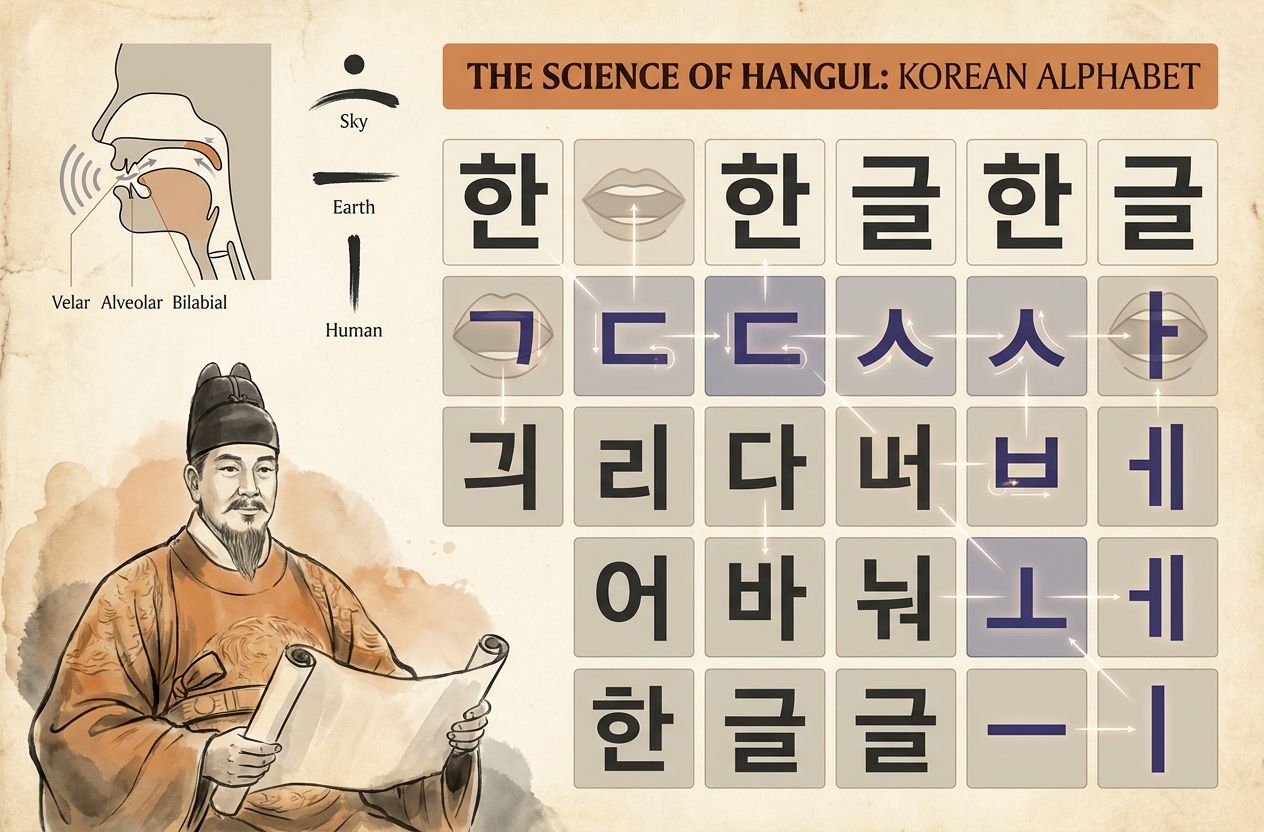
Hangul is the modern writing system of Korea, notable for being a deliberately designed script optimized for simplicity, logic, and accessibility. In this long-form guide we explore the origin, structure, historical trajectory and social consequences of Hangul, offering practical context for language learners, amateur linguists, and cultural enthusiasts.
Introduction: Why the Korean alphabet matters?
For centuries before Hangul’s invention, Koreans predominantly wrote in Classical Chinese (Hanja), a system that posed significant barriers to the broader population. When King Sejong the Great commissioned a new script in the 15th century, he and his scholars prioritized literacy as a public good. The result—Hangul—was a radical departure from organically evolved alphabets: it was a planned, phonologically informed system created to be learned quickly and used broadly.
Historical context: The birth of Hangul
The creation of the Korean alphabet dates to the early Joseon Dynasty. In 1443 King Sejong initiated a royal project to produce a native writing system. The outcome was documented in the Hunminjeongeum (1446), which can be translated as “The Proper Sounds for the Instruction of the People.” The text explained the new letters and their rationale: to enable common people to express the Korean language accurately and to increase literacy.
The main historical milestones:
- 1443–1446: Composition and promulgation of Hunminjeongeum.
- 15th–19th centuries: Hangul coexisted with Hanja; it was often stigmatized as the script of women and commoners.
- 20th century: National movements and modern education policies promoted Hangul, especially after the Japanese occupation and during the postwar era.
- Today: Hangul is the official script of both South and North Korea and is celebrated annually on Hangul Day (October 9 in South Korea, January 15 in North Korea).
For more on Hunminjeongeum and its UNESCO recognition, see the UNESCO Memory of the World entry: UNESCO. The original document remains a primary source for scholars.
Design principles: Why Hangul is linguistically clever
Hangul is neither an alphabet in the narrowest sense nor a pure syllabary; it blends features of phonemic alphabets with block-based visual organization. Several principles make it remarkable:
1. Phonetic intention and articulatory design
Many of the basic consonant shapes mimic the position of the articulators (tongue, throat, lips) when producing the sounds. For example, certain characters visually echo the shape of the mouth or tongue placement. Vowel letters were designed using simple strokes representing heaven (dot/point originally), earth (horizontal line) and human (vertical line), reflecting philosophical influences in the design.
2. Syllabic blocks
Rather than writing letters in sequence like Latin script, Hangul groups letters into fixed-size syllable blocks (e.g., 한 = ㅎ + ㅏ + ㄴ). Each block represents one syllable and contains an initial consonant (onset), a medial vowel (nucleus), and sometimes a final consonant (coda). This compact arrangement enhances readability, mirrors spoken syllable structure, and allows efficient use of vertical and horizontal space.
3. Economy and learnability
Hangul was designed to be learned quickly: the basic set of letters is limited and systematically derivable. Historically, King Sejong’s court noted that a commoner could learn the letters in a matter of days. Contemporary studies repeatedly show Hangul’s high learnability relative to logographic systems—contributing to rapid literacy gains when the script was adopted in education.
Structure and components of the Korean alphabet
Understanding Hangul requires familiarity with its two primary components: jamo (letters) and the rules for forming syllable blocks.
Jamo: consonants and vowels
The core set of jamo includes:
- Consonants: Basic consonants (ㄱ, ㄴ, ㄷ, etc.) and double consonants (ㄲ, ㄸ, ㅃ, ㅆ, ㅉ) that represent stronger or tense sounds.
- Vowels: Simple vowels (ㅏ, ㅑ, ㅓ, ㅕ, etc.) and compound vowels (ㅐ, ㅒ, ㅔ, ㅖ, ㅘ, ㅢ, etc.) formed by combining basic strokes.
Each jamo has a phonemic value and sometimes historical orthographic contexts. Modern standard Korean orthography uses a defined set of jamo encoded in Unicode, making Hangul fully supported in computing environments. For the Unicode Hangul blocks, see the Unicode Consortium documentation: Unicode Charts.
Forming syllables
Syllable formation follows consistent rules. Blocks are arranged depending on the vowel shape:
- Vertical-medial vowels (e.g., ㅏ) place the vowel to the right of the initial consonant.
- Horizontal-medial vowels (e.g., ㅡ) place the vowel below the initial consonant.
- Complex syllables with codas stack the final consonant under the nucleus or combine codas when needed.
This systematic geometry helps learners predict visual patterns and link pronunciation to graphic form more directly than many other scripts.
Social and cultural impact: Literacy, identity, and power
The adoption of the Korean alphabet had profound effects far beyond phonetics. Some of the most important impacts include:
1. Mass literacy and education
By lowering the barrier to literacy, Hangul contributed to expanded educational access across social classes. Schools and printing in Hangul enabled widely available texts—religious, administrative, and popular literature—allowing more Koreans to read and write in their native language. During the 20th century, national movements and modern education policies further entrenched Hangul as the primary medium of instruction, driving near-universal literacy.
2. Cultural identity and nationalism
Hangul became a symbol of Korean identity, especially during periods of foreign domination. During the Japanese occupation (1910–1945), the teaching and publication of Korean language materials were restricted; preserving Hangul and Korean literature became acts of cultural resistance. After liberation, promotion of Hangul was integral to nation-building and modern Korean identity.
3. Democratization of knowledge
With easier writing and printing, knowledge dissemination broadened: medical tracts, agricultural manuals, and popular literature reached people who previously lacked access to education. This democratization facilitated social mobility and public engagement with new ideas.
Hangul in practice: Learning tips for language students
For students and autodidacts approaching the Korean alphabet, here are practical suggestions to accelerate progress:
- Start with jamo shapes and sounds: Learn the basic consonants and vowels, focusing on the articulatory cues that many characters encode.
- Practice syllable blocks: Compose and decompose syllables to connect letters to spoken syllables (e.g., break 한 into ㅎ + ㅏ + ㄴ).
- Use spaced repetition: Flashcards for jamo and common syllables help memory consolidation.
- Read simple texts: Children’s books, graded readers, and Korean-language learning sites provide high-frequency exposure.
- Listen and repeat: Pair written forms with audio to strengthen orthography-to-sound mapping.
Helpful resources include the National Institute of Korean Language (korean.go.kr) for standards and orthography guides, and online courses like Talk To Me In Korean for structured lessons.
Technological and modern considerations
Hangul adapted smoothly to printing technologies and later to digital encoding. The block structure presented initial typesetting challenges but was easily standardized for movable type. In the computing era, Hangul is fully supported by Unicode, and software handles syllable composition algorithmically—allowing effortless typing and display across devices.
Additionally, Hangul inspired typographic creativity: designers experiment with fonts that emphasize geometric or calligraphic traits while preserving legibility. The script’s block-based nature makes it highly adaptable for logos, signage, and modern graphic systems.
Common myths and clarifications
Several misconceptions surround the Korean alphabet:
- Myth: Hangul is “perfect” and without irregularities. Reality: While highly systematic, Hangul’s modern orthography includes historical spellings, assimilation rules, and exceptions that learners must master.
- Myth: Hangul replaced Hanja overnight. Reality: Hanja coexisted with Hangul for centuries, particularly in formal domains; full transition was gradual and shaped by social, political, and educational reforms.
Case studies: How Hangul changed communication
Two short case studies illustrate Hangul’s social effects:
Printing and the spread of vernacular literature
After Hangul’s invention, printed pamphlets and instruction manuals in Korean multiplied. The availability of vernacular texts enabled more effective communication of practical knowledge—agriculture, medicine, and folk wisdom—which improved everyday life for many Koreans.
National movements and modern media
In the 20th century, newspapers, novels and educational material in Hangul helped foster a modern public sphere. Writers and journalists used Hangul to reach a mass readership, accelerating social discussion and political mobilization.
Practical next steps and resources
If you want to deepen your knowledge of the Korean alphabet and Korean language:
- Study jamo with a reliable primer or app (e.g., Hangul charts from the National Institute of Korean Language).
- Practice by reading graded materials and transcribing audio.
- Explore historical texts (translations of the Hunminjeongeum) to appreciate the script’s original intent: a key source is academic translations available through university presses and databases.
- Engage with communities—language exchange partners, forums, and social media groups focused on Korean learning.
Further reading: an accessible historical overview is available on Wikipedia; for primary-source studies, consult academic translations or UNESCO documentation on Hunminjeongeum.
Conclusion: The legacy of the Korean alphabet
Hangul stands out among world scripts for being a consciously engineered system that balanced linguistic insight with social purpose. The Korean alphabet made literacy feasible for broad segments of the population, strengthened cultural identity, and facilitated communication across centuries. For language learners and cultural enthusiasts, Hangul offers both an elegant writing system and a window into Korean history, philosophy, and social change.

By studying Hangul’s form and history, learners not only acquire a practical skill but also connect with a transformative moment in the history of writing: a deliberate design that reshaped a nation’s ability to read, write, and communicate.

Author’s note: This article is intended as an in-depth, accessible guide for learners and curious readers. If you’re beginning to learn Korean, start with basic jamo practice and gradually build toward reading entire syllable blocks—Hangul rewards patience with rapid gains in comprehension and fluency.