
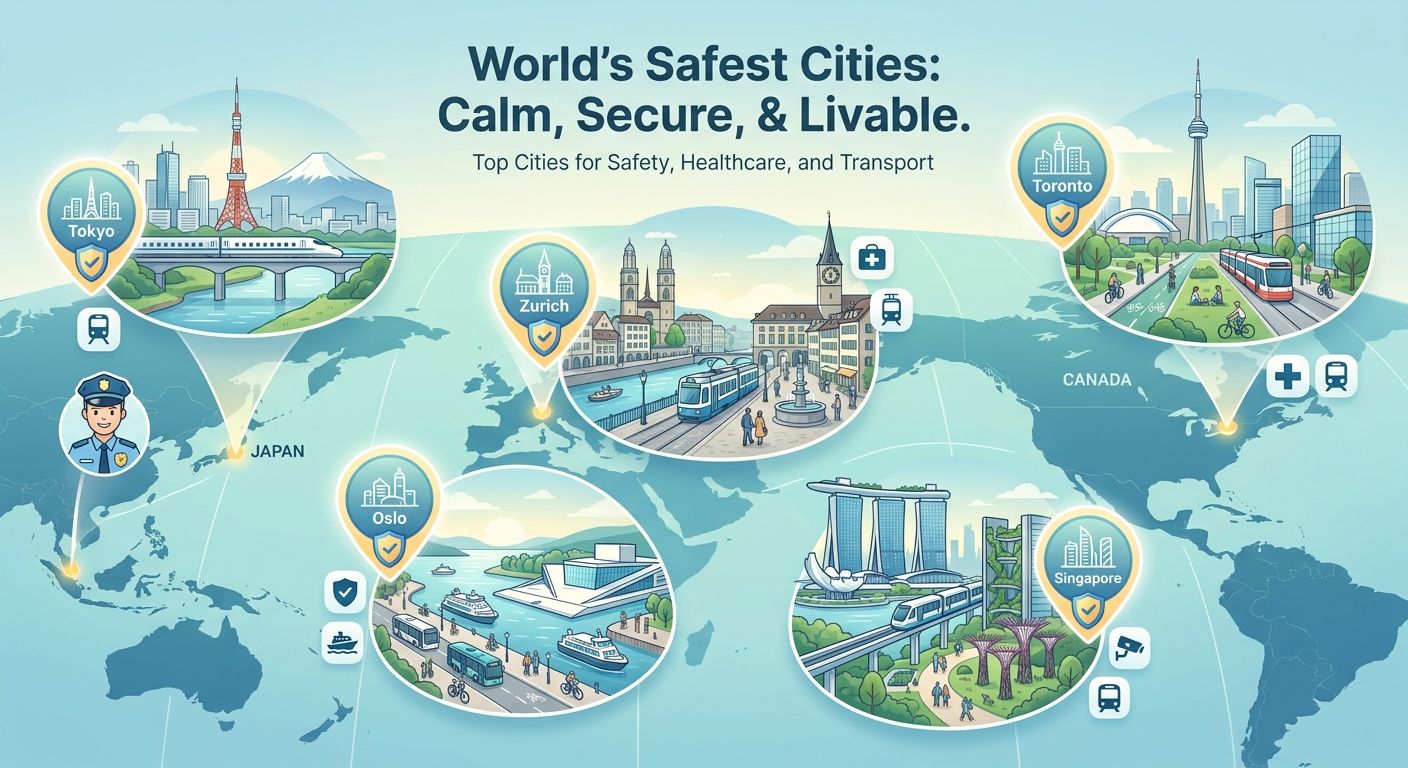
Safest cities are more than just places with low crime rates — they combine strong infrastructure, reliable public services, and a high quality of life. This guide presents a verified and practical ranking of the top 20 safest cities worldwide to help individuals, families, expatriates and professionals make informed relocation decisions.
How this ranking was built
To create a trustworthy ranking we analyzed multiple dimensions: official crime statistics, police response and trust indexes, urban infrastructure and transport reliability, healthcare access, environmental quality, and social stability. Sources include international indexes such as the Economist Intelligence Unit, Mercer Quality of Living reports, WHO and OECD data, and respected local crime datasets. Where possible we prioritized the latest publicly available 2024–2026 data to ensure the ranking is up-to-date.
Key indicators used
- Crime and personal safety: violent and property crime rates, perception of safety.
- Infrastructure and transport: quality of roads, public transit, reliability.
- Healthcare and emergency services: hospital availability and emergency response times.
- Economic and social stability: income levels, unemployment, social cohesion.
- Environmental quality: air quality, green spaces and resilience to natural hazards.
Note: No single index can capture every nuance. Use this ranking as a starting point and combine it with local research, visits and expat community feedback.
Top 20 safest cities in 2026 — Ranking
The list below highlights each city with a brief assessment of why it ranks among the safest cities, including practical relocation tips for families and expatriates.
- Tokyo, Japan — Internationally recognized for low violent crime and world-class public safety systems. Excellent public transport, advanced healthcare and high disaster preparedness make Tokyo a top choice. Tip: learn basic Japanese phrases and emergency procedures; register with your embassy.
- Zurich, Switzerland — Exceptional public services, strong rule of law and low crime rates. High-quality healthcare and clean environment. Tip: budget for a higher cost of living and explore canton-level residency services.
- Singapore — Strict law enforcement, efficient governance and pristine public spaces. World-class healthcare and public transit. Tip: research housing zones and school options early—demand is high.
- Oslo, Norway — Low crime, excellent social support systems and strong healthcare. High environmental quality and family-friendly neighborhoods. Tip: plan for winter conditions and take advantage of outdoor recreation for family life.
- Helsinki, Finland — Consistently high on safety and happiness indexes, with robust digital services and low crime. Great education system for families. Tip: investigate local daycare and schooling options as places fill quickly.
- Vienna, Austria — Renowned for quality of life, safe neighborhoods and reliable public services. Cultural amenities and green spaces abound. Tip: explore municipal housing and local commuter networks for best neighborhoods.
- Copenhagen, Denmark — Low crime and highly walkable neighborhoods with excellent cycling infrastructure. Strong welfare systems support families. Tip: familiarize with cycling rules and winter preparedness.
- Munich, Germany — Secure, economically stable and well-served by transit and healthcare. Family-oriented neighborhoods and strong schooling options. Tip: consider proximity to international schools and public transport hubs.
- Reykjavik, Iceland — Extremely low crime and strong community cohesion. Clean environment and excellent emergency readiness. Tip: research heating and insulation considerations for homes.
- Toronto, Canada — One of North America’s safer major cities with diverse communities, strong public health and solid urban infrastructure. Tip: check neighborhood crime maps and local transit commute times.
- Melbourne, Australia — High quality of life, low violent crime and reliable public services. Excellent cultural and education options for families. Tip: be mindful of regional weather patterns and housing markets.
- Wellington, New Zealand — Compact, safe and community-focused with good access to natural areas and healthcare. Tip: coastal living considerations and seismic preparedness are important.
- Amsterdam, Netherlands — Low crime in residential districts, excellent cycling infrastructure and healthcare. Tip: research housing supply and local school registration processes early.
- Stockholm, Sweden — Strong social systems, low violent crime and high living standards. Tip: examine municipal services and childcare enrollment timelines.
- Berlin, Germany — Generally safe with vibrant cultural life; certain neighborhoods are safer than others—do neighborhood-level research. Tip: use local police safety reports and community groups for up-to-date advice.
- Geneva, Switzerland — Diplomatic hub with strong public safety, healthcare and multilingual services. Tip: consider international school options and bilingual community resources.
- Luxembourg City, Luxembourg — Small, wealthy and secure with low crime and high public services. Tip: cross-border commuting is common — plan residency and taxation with professionals.
- Barcelona, Spain — High safety in residential areas, excellent healthcare and strong expat networks; be mindful of petty theft in tourist zones. Tip: choose quieter neighborhoods and register with local services.
- Basel, Switzerland — Strong healthcare and public services, low crime and a strategic location in Europe. Tip: explore multilingual schooling for expatriate children.
- Vancouver, Canada — High quality of life, safe neighborhoods and abundant green spaces. Tip: research local housing costs and neighborhood walkability.
Practical relocation considerations
When choosing among the safest cities, consider the following:
- Neighborhood-level safety: Safety varies by district; check local crime maps and speak to residents.
- Cost of living vs. safety: Higher safety often comes with higher living costs—balance budgets accordingly.
- Healthcare and insurance: Confirm coverage for expatriates and family members.
- Education and childcare: Investigate school availability, language of instruction and enrollment timelines.
- Transport and commute: Evaluate daily commute times and public transit reliability.
Steps to evaluate a city
- Review official crime statistics and perception surveys (e.g., local police reports, national statistics agencies).
- Check international indexes (Economist Intelligence Unit, Mercer, WHO) for comparative context — see external references below.
- Visit neighborhoods, use local forums and expat groups to gather firsthand impressions.
- Calculate total cost of living, including housing, transport and healthcare.
- Contact embassies or relocation specialists for paperwork and residency guidance.
Sources and further reading
For additional context, consult reputable sources such as:
- Economist Intelligence Unit (EIU) — Safe Cities and urban resilience reports.
- Mercer — Quality of Living rankings and expatriate guidance.
- World Health Organization (WHO) — Public health and environmental data.
- OECD — Social and economic indicators.
Final recommendations
Selecting a safe city requires balancing objective indicators and personal priorities. Use this top 20 list as a research framework: dig into neighborhood data, consider family needs or career opportunities, and plan at least one exploratory visit when possible. Safety, infrastructure and quality of life are interlinked — the best choice is the one that aligns with your values and practical needs.
FAQ
Are the safest cities always the most expensive?
Not always, but many cities with top safety indicators have higher living costs. Consider suburbs or smaller cities in the same region for better affordability while maintaining safety.
How often should I re-check safety data?
Safety metrics can change with economic shifts, policy or social trends. Revisit data annually and monitor local news and expat forums for on-the-ground developments.
Prioritizing safety and quality of life will help you and your family thrive in a new city.